

Durable Name Labels for Kids: The 2026 Parents' Guide
Thicker stickers don't keep your child's gear safe; they just give restless little fingers an easier edge to pick at. If you've ever pulled a lunchbox from the dishwasher only to find a soggy, curling mess, you know the frustration. Finding durable name tags for kids shouldn't mean constantly scrubbing away sticky residue or digging through the school lost-property bin for missing drink bottles. You just want labels that stay put through busy kindy days and muddy weekend sports without fuss.
Real longevity comes down to clean surface bonding and borderless transfer finishes rather than heavy layers of plastic. In this guide, you'll discover how to choose resilient labels that handle daily hand-washing, outdoor play, and active family routines. We'll explore why modern no-background transfers grip smooth, hard surfaces so effectively, how curing times protect your containers, and the simple application steps that keep your gear clearly identified all year round.
Key Takeaways
- Understand why borderless contact and surface bonding make durable name tags for kids stay put far better than thick stickers with exposed edges.
- Discover the visual and practical benefits of UV DTF transfers, giving lunchboxes and drink bottles a sleek, no-background finish that resists everyday handling.
- Learn which school items and surfaces, from stainless steel bottles to smooth plastic containers, provide the best grip for daily kindy and school routines.
- Master the crucial curing guidelines, including waiting 24 hours before standard use and 72 hours before dishwasher exposure, to give transfers the strongest hold.
- Find out how reliable labelling cuts down on school lost-property visits and prevents the expense of replacing misplaced items term after term.
What Makes Name Tags for Kids Truly Durable?
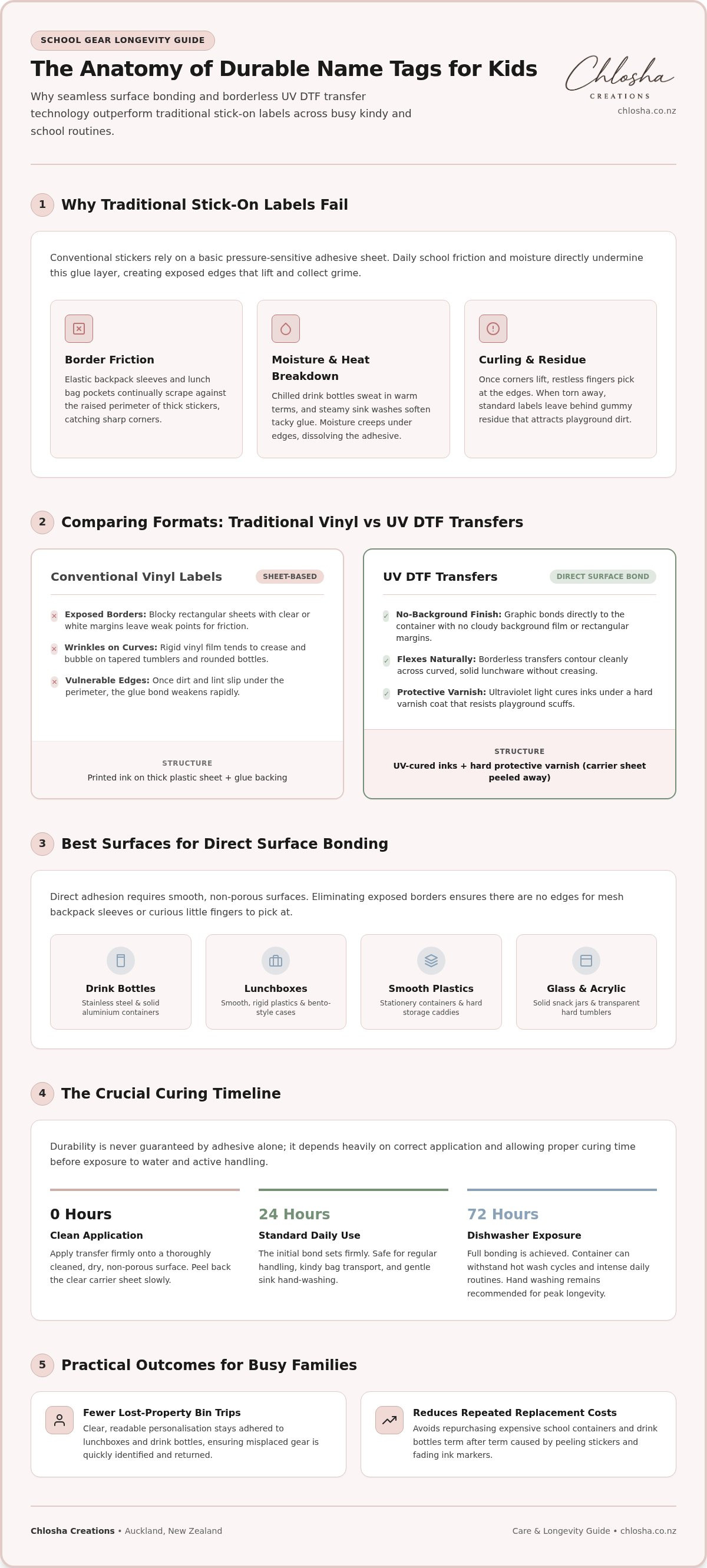
Most parents assume a thicker sticker equals better protection. In reality, sheer bulk is often the exact reason a label lifts. Genuine durability relies on surface bonding rather than adding heavy layers of plastic. When searching for durable name tags for kids, the goal is direct adhesion that integrates cleanly with your child's containers, leaving no vulnerable points behind.
Daily routines put intense stress on labelled items. School containers face constant physical contact, steamy sink washes, and sudden temperature shifts. Standard stickers rely on a basic pressure-sensitive adhesive that softens when exposed to hot water or moisture. Once that bond weakens, the edges lift, dirt slips underneath, and the label peels away entirely. True resilience depends on matching the right transfer style to a smooth, non-porous surface and allowing adequate curing time for the initial bond to set.
Why Traditional Stick-On Labels Often Fail
Paper-based stickers absorb moisture almost immediately, turning pulp-like after a single rinse. Conventional printed vinyl labels fare slightly better at first, but hot wash cycles gradually dissolve their tacky glue layer. This breakdown causes unsightly fraying around the perimeter. Worse yet, when these stickers eventually tear off, they leave behind gummy, stubborn residue that attracts grit and proves difficult to clean off lunchware.
The Role of Surface Friction and Moisture
Mechanical rubbing is an everyday enemy of school gear. Consider what happens when your child pushes a stainless steel bottle into a tight backpack pocket:
- Friction along borders: Heavy elastic sleeves scrape against the raised perimeter of thick stickers, catching corners dozens of times a day.
- Condensation buildup: Chilled water bottles sweat during warmer summer terms, forcing moisture directly beneath partially lifted edges.
- Border lifting: Without a clean, edge-free application, moisture and friction combine to strip the label away completely.
Eliminating exposed borders is the key to creating durable name tags for kids. When a transfer sits completely flush against a container with a smooth, no-background finish, there is simply no raised plastic border for backpack mesh to grab or curious little fingers to pick.
Comparing Label Types: UV DTF Transfers vs Traditional Vinyl
Walk through any primary classroom, and you will spot two distinct approaches to labelling. On one side are conventional printed vinyl stickers, featuring blocky rectangular sheets with clear or white margins. On the other side are modern UV DTF (direct-to-film) transfers, which sit seamlessly against the surface. Understanding how these formats differ helps you choose genuinely durable name tags for kids without relying on exaggerated marketing claims.
Traditional vinyl stickers consist of ink printed onto a plastic sheet backed by glue. While fine for flat binders, that perimeter border creates an immediate vulnerability on curved drink bottles. UV DTF technology takes a completely different path. Instead of sticking down a film sheet, the design transfers directly onto the container as an individual, borderless graphic.
Understanding UV DTF Transfer Technology
UV DTF transfers use ultraviolet light to cure specialised inks during printing, finishing with a hard, protective varnish layer. When applied, only the design elements bond to your item. The carrier sheet peels away, leaving a smooth, slightly raised finish that feels printed directly onto the container. There is no cloudy background film, no rectangular outline, and no unnecessary margin to gather grime.
Key Differences in Daily Performance
The everyday durability of your containers depends heavily on how the label interacts with daily bumps and playground scuffs. Here is how the two styles compare across active school routines:
- Border integrity: Rectangular vinyl stickers rely on edge seal. Once a corner lifts, lint and dirt destroy the glue. UV DTF transfers possess no background border, removing the mechanical weak point entirely.
- Scratch resilience: The cured varnish coat on UV DTF transfers provides high resistance against scuffs from concrete playground benches and metal desk cubbies.
- Surface fit: Rigid vinyl often wrinkles on tapered tumblers. Borderless transfers flex naturally across curved, solid lunchware without creasing.
While no decal can be called completely indestructible, direct transfers handle family routines exceptionally well on smooth plastics, stainless steel, and glass. For parents updating school gear, exploring purposeful school name labels designed with transfer technology offers a sleek, tidy solution that keeps containers identified without peeling away.
How to Choose the Right Name Tags for Every School Item
Every piece of school kit has its own quirks. A narrow felt-tip pen demands a completely different approach than a powder-coated lunchbox or a curved bike helmet. Selecting durable name tags for kids means matching the decal format directly to the surface material and size of each item, ensuring a lasting bond from the first day of term.
Surface texture dictates your success. Premium direct-to-film transfers grip exceptionally well on smooth, non-porous materials like stainless steel, rigid plastics, acrylic, and clean glass. In contrast, heavily textured surfaces, pliable silicone lids, and untreated fabric weaves don't offer enough continuous surface contact for the adhesive layer to anchor properly. Getting the surface right upfront saves you time and prevents lost gear later.
Labelling Drink Bottles, Lunchboxes, and Snack Tubs
Daily lunch containers need clear identification that supervisors can spot across a busy kindy mat or school playground. Mid-sized decals work best here. On curved insulated bottles, apply the label vertically along the smoothest flat section, well clear of the base rim where desk friction is highest. Applying personalised name labels directly to flat lid panels or untextured container sides gives the transfer maximum contact area for daily washing routines.
Stationery, Rulers, and Small Classroom Supplies
Classroom supplies get mixed up constantly during group activities. Here is how to keep smaller tools organised:
- Felt pens and pencils: Use compact Mini or Slim transfers placed along the flat barrel to prevent fingers from rubbing the edges during writing.
- Rulers and pencil cases: Apply Middle sizes along solid plastic edges or acrylic surfaces where the design stays visible inside desks.
- Calculators and tech gear: Position clean transfers across the hard outer casing away from sliding battery doors.
Choosing balanced formats like Classic or Middle packs gives families enough variety to cover an entire stationery list in one go.
Helmets, Scooters, and Sports Gear
Outdoor equipment takes heavy punishment on tarmac and sports fields. Hard-shell bike helmets, scooter stems, and plastic shin guards require high-visibility labelling that withstands wet turf and scuffs. Big Gear and Mega pack sizes deliver bold, easily spotted text for shared equipment racks. For toddlers and early learners who haven't started reading, themed Icon + Name label formats pair simple graphics with first names, letting little ones identify their own gear instantly.
How to Apply and Care for Kids' Name Labels to Last
Even the highest quality transfers need proper surface preparation to perform at their best. Durable name tags for kids don't fail because the ink gives out; they lift because natural oils or dust prevented the adhesive from forming a solid seal. By pairing methodical application with patient curing times, you ensure your lunchboxes and drink bottles stay clearly identified throughout the school year.
The secret lies in the bond created between the direct transfer film and your hard surfaces. Rushing this initial phase cuts the transfer's working life short, while allowing adequate settling time lets the bond achieve its full grip before facing daily sink duty.
Preparing the Surface Properly
Clean surfaces make all the difference. Wash the item thoroughly using warm, soapy water to remove daily grease, or wipe the area down with isopropyl alcohol to strip stubborn factory residues. Dry the surface completely with a clean microfibre cloth so no lint remains behind. Steer clear of textured mould lines or ribbed panels, as tiny air pockets under these ridges invite moisture to seep inward over time.
Step-by-Step Transfer Application
Applying borderless transfers requires just a few precise movements:
- Align and position: Lay your container on a steady surface. Position your decal carefully, as the high-tack layer grips firmly on contact.
- Apply firm pressure: Rub across the clear carrier sheet using your thumb or an application tool, pressing down every part of the lettering.
- Peel back slowly: Roll the carrier film back at a flat, low angle against the container. If a small detail begins to lift, press the film back down and rub again.
- Settle stubborn spots: If you are applying to cold plastic during winter, warming the item gently with a hair dryer on a low setting softens the bond nicely.
Ongoing Cleaning and Maintenance Tips
Curing is where many parents get caught out. Give the item a full 24 hours of rest before packing it for school or kindy. If you plan on running the container through the top rack of a dishwasher, wait at least 72 hours so the adhesive cures fully. When hand-washing, use a soft sponge rather than a metal scourer across the design. These straightforward habits keep durable name tags for kids bright and firmly bonded through every busy term.
Ready to get your household gear sorted properly? Browse our collection of personalised name labels to set up your school containers for the year ahead.
Keep School Gear Organised with Thoughtfully Made Name Labels
Replacing lost stainless steel drink bottles and bento lunchboxes every term quickly adds up. A single missing lunch set can leave you out of pocket, not to mention the hassle of rummaging through overflowing school lost-property tubs on a Friday afternoon. Investing in durable name tags for kids isn't merely about aesthetics; it provides practical reassurance that your child's everyday kit stays properly identified wherever their routine takes them.
Clear labelling turns chaotic morning rushes into smooth transitions. When lunchware, sports gear, and stationery cases carry clean, legible identification, teachers can return misplaced items straight to your child's desk before they vanish into shared school bins.
Selecting the Best Pack for Your Household
Every home manages organisation a little differently. Choosing a layout tailored to your specific routine prevents half-empty sheets from sitting forgotten in kitchen drawers:
- Single-child setups: Classic Name packs provide a balanced mix of sizes to tag core lunchware, pencil containers, and school essentials.
- Multi-child families: Sibling packs let you split customised names across one convenient order, coordinating distinct fonts or subtle icon accents for each child.
- High-volume prep: Mega packs deliver extra transfer volume for busy households kitting out kindy bags, sports kits, and classroom stationery all at once.
To plan out your household system across different ages and stages, our guide on personalised name labels in NZ offers practical ideas for structuring school gear across the family.
Simple Labelling Solutions for Busy Families
Opening the kitchen cupboard to find matching, clearly identified containers brings quiet satisfaction to everyday family routines. Rather than dealing with curling paper corners or sticky vinyl residue, choosing borderless transfers gives lunchboxes and water bottles a refined, printed-on look that endures regular washing.
Take the guesswork out of school organisation this term. Discover our collection of durable name tags for kids to find clean, long-lasting transfer solutions designed to keep pace with your family's daily adventures.
Set Up Your School Gear for the Long Haul
Reliable labelling doesn't have to be an endless cycle of peeling corners and replacement bottles. By choosing borderless UV DTF transfers over bulky stickers, you eliminate the lifted edges that backpack pockets love to catch. Pairing clean, oil-free surface prep with patient curing ensures your drink containers and bento boxes stay clearly marked through daily classroom use and playground rough-and-tumble.
Whether you need a versatile Classic setup for a new school starter, a high-volume Mega pack, or a split Sibling pack, having the right layout makes term organisation feel effortless. The sleek, printed-on finish keeps everyday essentials looking smart without messy glue residue left behind. Take a moment to find the perfect durable name tags for your kids' gear and enjoy the quiet peace of mind that comes with knowing their everyday favourites will actually make it home.
Frequently Asked Questions
Can durable name tags for kids be put through the dishwasher?
Yes, but success depends on correct curing. While no label should be claimed as permanently indestructible, UV DTF transfers can handle gentle, top-rack dishwasher cycles once fully set. You must wait at least 72 hours after initial application before exposing the container to hot water cycles. Hand washing with a soft cloth remains the gentlest way to prolong decal vibrancy.
What is the difference between UV DTF name tags and standard vinyl stickers?
Standard vinyl stickers are printed on solid plastic film sheets that leave a clear or white border around the name. In contrast, UV DTF transfers bond directly onto the item with cured inks and a protective top coat. When you remove the carrier film, only the raised design remains, giving a borderless, printed-on finish without peeling margins.
Why do name stickers peel off my child's drink bottle?
Peeling usually happens because of surface oils, sharp curves, or friction against backpack pockets. Traditional stickers feature exposed perimeter edges that snag easily against elastic bottle holders. Condensation on chilled bottles also breaks down standard pressure-sensitive adhesives. Choosing borderless transfers applied to completely degreased, smooth surfaces prevents these edges from catching and lifting over time.
Can I use these name tags on school uniform clothing or socks?
No, these transfers are not suitable for clothing, socks, or fabric hats. Premium UV DTF decals are engineered specifically for smooth, non-porous hard surfaces. They cannot flex with woven textiles or endure laundry wash cycles on garments. For school uniforms, you will need dedicated clothing tags designed specifically for fabric integration.
How long should I wait after applying a name tag before washing the item?
Patience during the first few days ensures the strongest bond. You should wait at least 24 hours before sending the labelled container to school for standard use or gentle rinsing. If you plan to wash the item in a dishwasher, allow a full 72 hours for the adhesive to cure completely against the hard surface.
What surfaces are best suited for long-lasting name tags?
The best surfaces are clean, smooth, and rigid. Stainless steel bottles, acrylic pencil cases, glass containers, and rigid lunchbox plastics offer excellent grip for durable name tags for kids. Decals will not adhere reliably to rubberised coatings, flexible silicone lids, rough fabric weaves, or low-energy plastics like untreated polypropylene.
Are icon and name combination labels helpful for younger children at kindy?
Icon and name pairings are brilliant for early learners who cannot read full words yet. Toddlers and kindy kids quickly recognise a chosen visual symbol, like a dinosaur, heart, or rainbow, on their personal bento box. This visual cue helps young children identify their own belongings independently on the kindy shelf while teachers read the printed text.
