

Allergy Alert Stickers: Practical Guide for NZ Families
What if an allergy label’s most useful role is to prompt a conversation, not carry the whole care plan? If you’re considering allergy alert stickers for school, it’s natural to want a clear reminder on a lunchbox or drink bottle and to wonder what wording to use.
A label can support communication about a child’s allergy, but it isn’t a substitute for sharing relevant information and agreeing arrangements with the school. This guide covers what to discuss before preparing labels, which belongings may be suitable, and how to choose wording and a surface carefully. You’ll also find practical application and care tips, so a label can serve as a helpful prompt without making unsupported safety claims.
Key Takeaways
- Use allergy alert stickers for school as visible prompts on selected belongings, not as a replacement for direct communication or agreed care arrangements.
- Ask the school which items to label, then confirm the wording and placement with the people caring for your child.
- Choose a label that’s easy to read and suited to the intended item. UV DTF decals are for compatible, clean, dry, smooth hard surfaces.
- Apply carefully: clean and dry the surface, position the decal, press firmly and peel the carrier back at a low angle. A warm hair dryer on low may help if needed.
- Allow time for the decal to cure before normal use, and consider the surface and care instructions when deciding how to clean the item.
How allergy alert stickers for school can support clear communication
A label on a lunchbox or drink bottle can make an allergy easier to notice when that item is being handled. It gives caregivers a visual cue to check the information and arrangements already shared with the family. An allergy alert sticker is an identification prompt on a personal item, not a medical instruction or a care plan.
Families may choose to label selected belongings that travel between home and school, especially items used around food. The label’s message should fit its purpose and be understood by the adults responsible for the child. General information about food allergy management can provide background, but the wording and practical next steps for a particular child should be confirmed with their caregivers and school.
What information should families confirm before labelling?
Before choosing a design or wording, talk with the school and the adults who care for your child. Ask what concise wording is appropriate, which belongings should carry it, and whether the child’s name or another identifying detail should be included. A school may already have a preferred way to record or recognise allergy information, so check rather than guessing.
Keep the message within what responsible adults have confirmed. Don’t add treatment steps, instructions or claims about what staff should do unless these have been agreed as part of the child’s arrangements. If the wording is unclear, pause and ask. A short, readable prompt is more useful than a crowded label whose meaning could be misunderstood.
What a school label can and cannot do
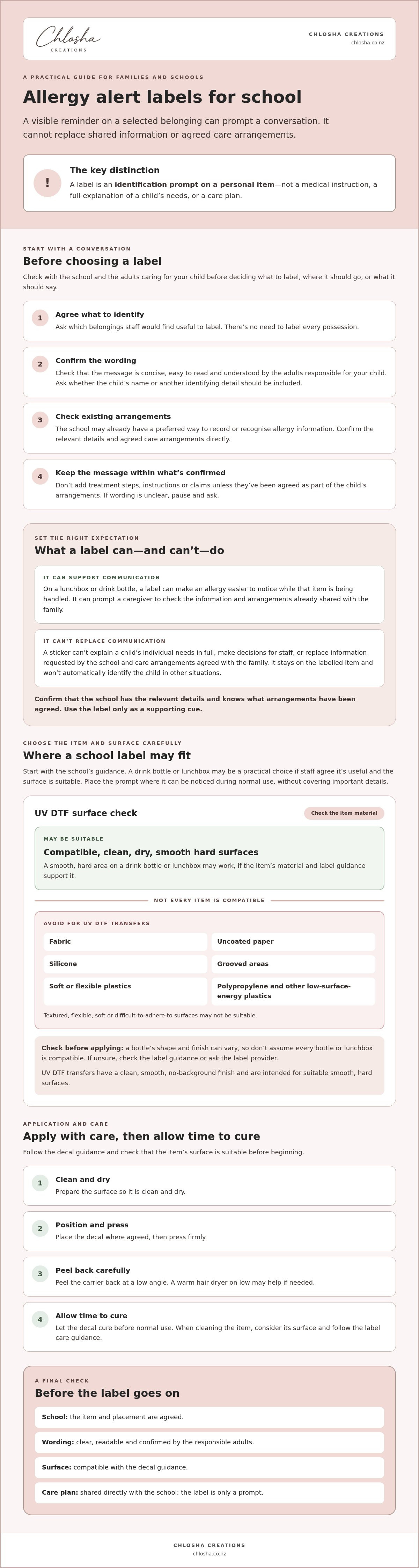
Think of the sticker as a visible prompt attached to one labelled item. It can help identify that item as belonging to a child with an allergy and encourage a caregiver to refer to the information they’ve been given. Ask staff how they’ll recognise and use the label, and whether its placement on the item will make it easy to see.
A sticker can’t explain a child’s individual needs in full, make decisions for staff, or replace information the school requests and care arrangements agreed with the family. Labels also stay with the item they’re applied to, so they don’t automatically identify the child in other situations. Clear communication still matters. Confirm the school has the relevant details and knows what arrangements have been agreed, then use a label only as a supporting cue.
Where to use school allergy alert stickers and what to label
Start with the school, not the sticker. Ask which belongings staff would find useful to identify and where a label should sit to be easy to notice. A drink bottle or lunchbox might be a practical choice if the school agrees and the item has a compatible surface. There’s no need to label every possession.
Keep the wording clear and readable, and consistent with the information confirmed by the family and school. Before choosing an item, check what it’s made from and whether the surface suits a UV DTF decal. These transfers have a clean, smooth, no-background finish, but they’re intended for suitable smooth, hard surfaces, not every kind of school gear.
Which school belongings may be suitable for a label?
A compatible drink bottle or lunchbox can provide a clear spot for an allergy identification prompt. Other smooth, hard belongings may also be suitable if the school agrees the item is useful and the label guidance supports that surface. Consider whether the label will be easy to see during normal use, without covering important details on the item.
If you’re also organising everyday belongings, browse personalised name labels NZ for school items. For an allergy alert, confirm the specific wording and placement with the school and caregivers first.
Which surfaces should families avoid?
Some surfaces aren’t suitable for UV DTF transfers because they’re textured, flexible, soft or difficult for a decal to adhere to. Avoid applying one to fabric, uncoated paper, silicone, grooved areas, or soft and flexible plastics. Polypropylene and other low-surface-energy plastics can also be poor choices.
Check the item material and label guidance before applying anything. A bottle’s shape or finish can vary, so don’t assume every drink bottle or lunchbox is compatible. If you’re unsure, check with the label provider rather than risking a placement that may not hold as intended.
For allergy alert stickers for school, choose an item the school has agreed is useful and that has a suitable surface. This helps keep the prompt visible and the wording aligned with the family’s communication plan.
Choosing an allergy alert label: wording, visibility, and suitability
A useful allergy label needs to be clear at a glance and appropriate for the item it’s going on. Check the wording with the child’s caregivers and school, then consider whether it will be readable in the chosen spot and whether the item has a suitable surface. A decal’s suitability depends on its wording, visibility, intended item and surface compatibility.
Allergy alert stickers for school can act as a visual cue, but they can’t prevent exposure or guarantee how a school will respond. Confirm the school’s preferred wording and placement, and make sure the label complements the information and arrangements already shared with staff.
How to keep allergy wording clear and current
Agree the exact wording with the child’s caregivers and school before ordering or applying a label. Keep it concise and make sure it matches the current information supplied by responsible adults. Avoid adding medical instructions or assumptions. If the child’s details or school arrangements change, review the label and check whether its wording still fits.
How to assess readability and label suitability
Look at the item as it’s normally used. Can the text be read easily where the label will sit, without being hidden by a hand, lid or curve? Choose a placement the school has confirmed will be useful. Chlosha Creations’ UV DTF transfers have a smooth, raised, no-background finish and are intended for suitable, clean, dry, smooth hard surfaces. A label’s durability depends on the surface, correct application and curing time.
Use this quick check before choosing:
| What to check | Practical question | Why it matters |
|---|---|---|
| Wording | Have the child’s caregivers and school confirmed the text? | Keeps the prompt aligned with information the responsible adults have agreed on. |
| Placement | Is the label easy to see in the spot agreed with the school? | A clear position helps staff notice the prompt on that item. |
| Surface | Is the item clean, dry, smooth and hard, and suitable for the decal? | Surface type, application and curing time affect how well the transfer holds. |
| Readability | Can the wording be read on the item without obstruction? | Small or obscured text may be harder to notice. |
Check each point before applying the label. A suitable design fits the confirmed wording and the specific item, not simply what looks appealing on its own.
How to apply and care for allergy alert UV DTF labels
Careful application helps a UV DTF transfer sit neatly on a compatible item. Before starting, check the label guidance and choose a clean, dry, smooth, hard surface. Dust, moisture, texture or an unsuitable surface can affect how well it adheres.
Applying a label to a suitable hard surface
Take your time with the position. It’s easier to place the transfer correctly before pressing it down. Follow this simple sequence:
- Clean the chosen area, then let it dry completely.
- Position the transfer where it will be easy to see and won’t interfere with using the item.
- Press firmly across the transfer, using a squeegee or firm pressure to help it adhere.
- Peel the carrier back low, keeping it close to the surface rather than pulling upwards. If needed, use a warm hair dryer on low to help with application.
If part of the design lifts as you peel, stop and press it down again before continuing. Follow any product-specific instructions supplied with the label.
Caring for the labelled item
Give the transfer time to cure before putting the item back into regular use. Allow about 24 hours before normal use and about 72 hours before dishwasher exposure, where appropriate. These are care guidelines, not a promise that every labelled item is suitable for a dishwasher. Check the item’s own care instructions, too.
Durability depends on choosing a compatible surface, applying the transfer correctly and allowing it time to cure. Even a well-applied decal may perform differently depending on the item’s material and finish. For a drink bottle or lunchbox, gentle handwashing may be a more suitable choice if you’re unsure about dishwasher exposure.
These steps can help prepare allergy alert stickers for school belongings, but the decal remains an identification prompt, not a substitute for the school’s agreed information and arrangements. If you’re also labelling other school items, you can browse personalised name labels and check that each item’s surface is suitable before applying one.
Preparing school allergy labels with confidence
A little preparation can make choosing a school allergy label more straightforward. Start with the school’s needs, then agree the wording with the adults responsible for the child. Choose an item the school has said is useful, check that its surface suits the decal, and apply it according to the supplied instructions.
These steps keep the label connected to the communication around it. Allergy alert stickers for school are visual prompts on specific belongings. They don’t replace sharing the information the school requests or confirming the arrangements agreed with staff and caregivers.
A parent’s final check before the school day
Before the item goes into a school bag, check that the practical details line up:
- School information: Has the school received the information it asked the family to provide, and have you confirmed how staff will use the label?
- Wording: Does the text match the current information and wording agreed by the family and school?
- Item and placement: Is the label on an item the school considers useful, and is it easy to see?
- Application and care: Does the transfer look securely applied? Follow the supplied care guidance and allow for the recommended curing time before normal use.
If something has changed, such as the information shared with the school or the agreed arrangements, check the wording again before relying on the label as a prompt. A quick review helps avoid carrying an outdated message forward.
Find labels for school belongings
Chlosha Creations offers an Allergy & Medical label range, as well as name labels for school and everyday belongings. UV DTF transfers have a clean, smooth, no-background finish and suit compatible smooth, hard surfaces. Check the particular item and label guidance before applying one, as materials and finishes can differ.
For a broader look at organising school belongings, the Name Labels collection is a useful place to explore. Choose a label that fits the item, and keep the school’s communication needs at the centre of your decision.
Make your school label choice with confidence
Choosing allergy alert stickers for school starts with a conversation, not a design. Confirm what information and wording the school needs, then choose an agreed item with a surface suitable for the label. A decal can be a helpful visual prompt, but direct communication and agreed care arrangements remain essential.
Chlosha Creations offers an Allergy & Medical label range, alongside premium UV DTF transfers with a clean, smooth, no-background finish for suitable hard surfaces. Surface choice, application and curing time all affect how a decal holds, so check the care guidance before putting a labelled item into regular use.
When you’re ready to organise other school belongings, explore the Name Labels collection and choose options suited to your child’s items and the guidance agreed with their school.
Frequently Asked Questions
Can allergy alert stickers replace a school allergy plan?
No. Allergy alert stickers for school are identification prompts on particular belongings, not replacements for information or arrangements agreed with the school. Confirm what details the school needs and how staff should recognise and use the label. Keep the information shared with the school current, and make sure the label’s wording matches it. A sticker alone can’t prevent exposure or provide the full context staff may need.
What should an allergy alert sticker for school say?
Agree the wording with the child’s caregivers and school rather than relying on a universal phrase. Keep it concise, accurate and consistent with the information responsible adults are providing directly to the school. The child’s name may help identify an item if the school and caregivers agree it’s appropriate. Don’t add medical details or emergency instructions that haven’t been confirmed, and review the wording if the shared information changes.
Where should I put an allergy alert label on school belongings?
Choose a position and item that the school considers useful for identifying the child’s belongings. A compatible drink bottle or lunchbox may be suitable if it has a smooth, hard surface that supports the transfer. Ask staff which belongings they’d like labelled and where the prompt will be easiest to notice. A label on one item is not the school’s only source of allergy information, so share relevant details directly too.
Can UV DTF allergy labels go on any lunchbox or drink bottle?
No. UV DTF transfers are intended for clean, dry, smooth hard surfaces, and the item’s material matters. Compatible glass, acrylic or hard plastic may suit, but check the specific item and label guidance before applying. Avoid textured or grooved areas, silicone, flexible or soft plastic, and polypropylene. Don’t assume two bottles or lunchboxes with a similar appearance have the same surface or will both be suitable.
How do I apply an allergy alert sticker to a school item?
Thoroughly clean and dry a suitable smooth, hard surface, then position the transfer and press or squeegee it firmly. Peel the carrier back at a low angle. A warm hair dryer on low may help if needed. Allow about 24 hours before normal use and about 72 hours before dishwasher exposure, where appropriate. Surface choice, application and curing time all affect durability, so follow the supplied care guidance.
Are allergy alert stickers waterproof or dishwasher-proof?
No specific performance is guaranteed for every item or wash cycle. How a UV DTF label holds up depends on the item’s surface, correct application and curing time. The care guidance recommends waiting about 72 hours before dishwasher exposure, where appropriate, but that isn’t a promise of dishwasher-proof performance. Check the item’s care instructions and the label guidance. If you’re unsure whether the surface or cleaning method is suitable, don’t assume it will hold.
Can I put an allergy alert sticker on school clothing?
No. Chlosha Creations’ UV DTF transfers are for suitable smooth, hard surfaces, not fabric or clothing. They aren’t designed as clothing labels. If you need to identify a uniform or other school clothing, ask the school what options are appropriate for that use. Keep any clothing identification separate from labels intended for items such as compatible drink bottles and lunchboxes, and don’t apply a transfer to fabric.
