

UV Resistant Decals for Outdoor Use and Their Lifespan
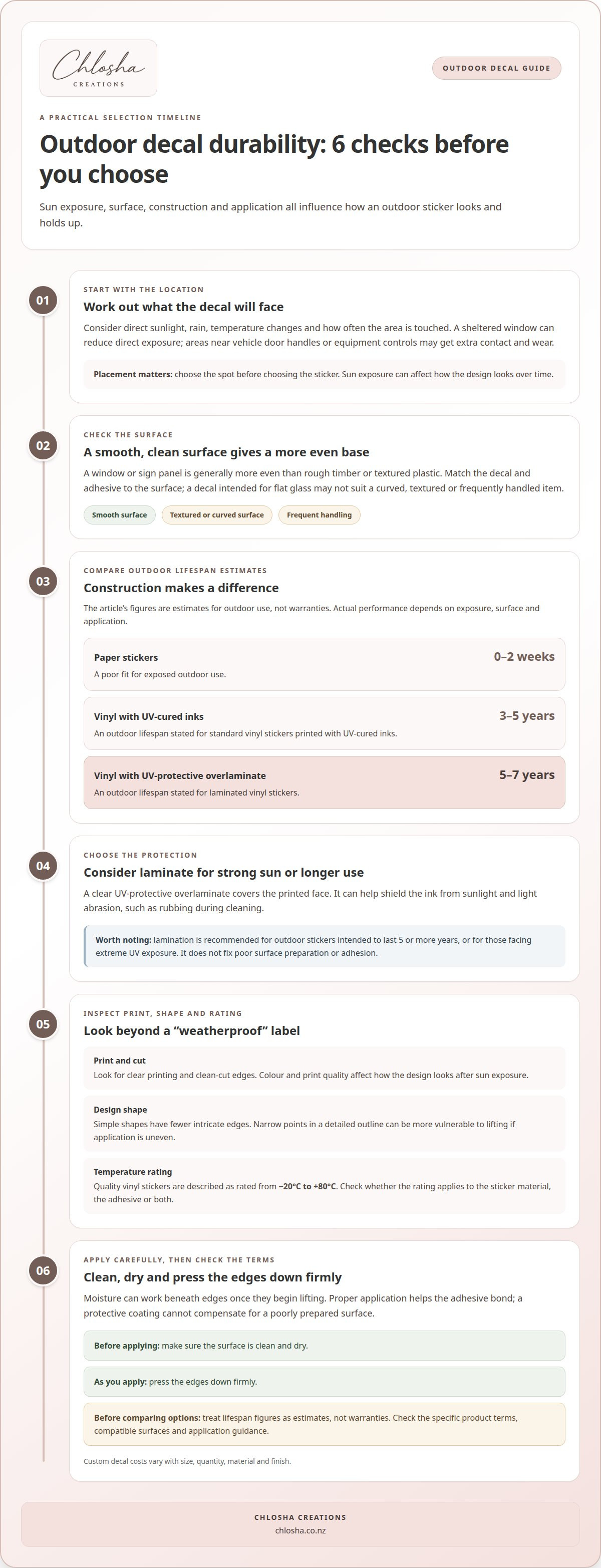
A sunny spot can shorten a sticker’s outdoor life faster than you might expect. Standard vinyl stickers printed with UV-cured inks have an outdoor lifespan of 3-5 years, while laminated vinyl stickers with a UV-protective overlaminate have an outdoor lifespan of 5-7 years. Choosing UV resistant decals for outdoor use means looking beyond the label: sun exposure, surface preparation and application all play a part in how well a decal holds up.
Material and laminate matter, but they’re only part of the picture. Print quality, colour and placement all affect how a decal looks outdoors, while a clean, dry surface helps it adhere properly.
This guide explains how long outdoor vinyl stickers may last and what influences their durability. You’ll learn what UV-protective laminate does, why print quality and colour matter, and which practical details to consider when choosing a decal for an outdoor surface.
Key Takeaways
- Standard vinyl stickers printed with UV-cured inks have an outdoor lifespan of 3-5 years; a UV-protective overlaminate can extend that to 5-7 years.
- Consider how much direct sun and weather the sticker’s location receives when choosing where to place it.
- For better adhesion, apply stickers to a clean, dry surface and press the edges down firmly.
- Colour choice and print quality affect how a design looks as it’s exposed to sunlight, so consider both when selecting an outdoor sticker.
- DIY Decal Sheets can help you create personalised designs for suitable items. Match the decal to the surface and the conditions it will face.
What are weather-resistant stickers?
Decals intended for outdoor use need materials and adhesives suited to exposure. Their performance also depends on the surface, placement, print and protection from sunlight and moisture.
Weatherproof materials and durability
Paper stickers are a poor fit for exposed outdoor use, with an expected lifespan of 0-2 weeks. Vinyl printed with UV-cured inks is designed for longer outdoor use; a UV-protective overlaminate adds another protective layer. Look at the full construction, not just a “weatherproof” label. Direct sun, rain, temperature changes, surface texture and lifting edges can all affect how long a sticker stays attached and legible.
Choose the spot before choosing the sticker. A smooth, clean window or sign panel gives the adhesive a more even surface than rough timber or textured plastic. In New Zealand, a sticker facing north may receive more direct sun than one facing south; south-facing surfaces receive 2-3 times more UV radiation. Sheltered windows can reduce direct exposure, while areas near a vehicle’s door handles or equipment controls may face extra contact and wear.
Outdoor and industrial applications call for different priorities. A label on a storage bin may need to stay readable through changing weather, while a safety notice on machinery must remain clear and attached. Match the material and adhesive to the surface and conditions. A decal designed for flat glass may not suit curved, textured or frequently handled equipment.
Professional sticker features
For professional outdoor stickers, look for clear printing, clean-cut edges and material suited to the intended surface. Temperature ratings can also matter: quality vinyl stickers are rated from -20°C to +80°C. Check whether the stated rating applies to the sticker material, the adhesive or both. Proper application matters too, because moisture can work beneath edges once they start lifting.
How much do custom outdoor UV-resistant decals cost in New Zealand? There’s no single price for every job. Size, quantity, material and finish all affect cost, so the right quote depends on the decal’s dimensions and intended use.
Which New Zealand suppliers offer UV-resistant outdoor decals, and what warranties do they provide? Product ranges and warranty terms differ, so don’t treat a lifespan estimate as a warranty. Read the terms for the specific decal, especially what they say about outdoor exposure, compatible surfaces and application.
To remove a decal from glass or painted surfaces, warm it gently with a hairdryer, then lift one corner with a fingernail or plastic card. Peel slowly, keeping the decal close to the surface instead of pulling sharply away. Remove leftover adhesive with warm soapy water and a soft cloth, testing a small, inconspicuous area first. Avoid metal blades and harsh solvents, which can scratch glass or damage paint.
UV-resistant laminate and fading protection
Outdoor prints face sunlight, moisture and abrasion, which can dull colours or damage exposed surfaces. The ink, decal material and protective finish work together, so assess the complete construction rather than just one feature.
For decals facing strong, prolonged sunlight, a UV-protective overlaminate adds a clear layer over the printed design. Laminated vinyl stickers with this coating have an outdoor lifespan of 5-7 years. Lamination is recommended for outdoor stickers intended to last 5 or more years, or for those facing extreme UV exposure.
How laminate helps protect a print
A clear UV-protective laminate covers the printed face without hiding the design. It can help shield ink from sunlight and everyday abrasion, such as light rubbing during cleaning. However, it won’t make adhesive bond to a poorly prepared surface. Clean application and firmly pressed edges remain important to keep moisture from creeping underneath.
Overlamination is applied over a printed decal. It isn’t the same as choosing UV-resistant ink, so think of them as separate parts of the construction. UV-cured inks form the printed image, while a UV-protective overlaminate adds a covering layer. The right combination depends on the surface, exposure and expected wear.
Choosing inks, coatings and shapes
What are the best outdoor decal printing methods: UV printing, solvent, or eco-solvent? No single method is best for every job. Compare the ink, decal material and protective coating as a complete system, then match them to the surface and exposure.
What materials make decals UV resistant for outdoor use? Vinyl, UV-cured inks and a UV-protective overlaminate can form a suitable combination. The printed surface and any clear coating matter too. The material alone doesn’t show how well a finished decal will handle sunlight.
Shape affects coverage. A simple square design has fewer intricate edges than a detailed outline with narrow points. Fine shapes can be more vulnerable to lifting if application is uneven. For a complex logo, consider whether a clear coating can cover the printed areas without obscuring small details.
Before choosing a finish, note where the decal will sit. A shaded window has different exposure from a sign in direct sun. If the design faces intense sunlight, prioritise UV protection; if it also encounters frequent contact, consider abrasion protection. For everyday identification rather than outdoor signage, personalised name labels may suit family items better.
How do you recognise a professional outdoor sticker?
Professional results depend on three practical details: suitable application temperature, careful surface preparation and even pressure. These steps help the adhesive bond properly, whether the decal is going on a window, vehicle panel or product.
Check the application temperature
Temperature affects adhesion and positioning. An outdoor sticker applied when it’s too cold may not bond as effectively. If the surface is too hot, positioning the design can be difficult. Surface temperature, rather than the weather forecast alone, is the useful guide.
A surface temperature of 15-25°C is ideal for applying outdoor stickers. Most manufacturers recommend application at approximately 10 to 25°C. These ranges overlap, but conditions and product guidance can differ. Avoid applying a decal to a sun-heated car panel or a cold window; wait until the surface reaches a suitable temperature.
Prepare and position the surface
Start with a completely clean, dry surface. Clean outdoor sticker surfaces thoroughly with isopropyl alcohol to remove residue that can interfere with adhesion. Follow the product’s cleaning instructions, especially on painted vehicle panels, coated windows or plastic products.
- Choose a flat area with enough room for the full design.
- Clean the area, then let it dry completely.
- Position the decal before pressing it down.
- Apply pressure across the design, paying close attention to its edges.
Take care when applying decals around curves. A vehicle door panel may curve more sharply near its edge than a flat window. Designs with narrow points or intricate outlines need even contact across their shape. If the decal shifts during placement, lifting and repositioning it can disturb adhesive contact.
For windows, choose a clear area away from moving parts, seals and corners. On a storage container, use a broad, smooth section instead of a ribbed or textured patch. For outdoor signage, place the design where it stays visible and won’t be rubbed during routine handling.
After application, press the edges firmly. Lifting can start at an edge and allow moisture underneath. A professional-looking finish has smooth contact, neat alignment and no trapped debris. Don’t rush: careful placement matters as much as the printed appearance.
These checks apply to decals on vehicles, windows, products and signs. Match the application method to the surface, then follow the decal’s instructions. A curved panel, for example, needs more deliberate positioning than flat glass, while textured plastic may not provide an even bonding area.
Colour matching and vibrancy
Colour affects more than an outdoor decal’s first impression. A shopfront logo, equipment label or vehicle graphic needs to remain recognisable as sunlight gradually affects the printed surface. Choose colours for brand consistency and practical visibility, rather than relying on a screen preview alone.
Start with your actual branding colours. Share the exact colour references used for your logo, if available, and review the artwork against its intended background. A pale blue design on a white window may have less contrast than the same blue on a dark panel. A small proof or sample can help you assess the overall look before committing to a larger design.
Screens display colour using light, while printed designs are viewed through reflected light. As a result, turquoise can look brighter on a phone than on a printed decal. Compare the proof on screen with the surface where the decal will appear. Check the design in daylight and shade, especially for windows or outdoor signage.
Sunlight can gradually change a print’s appearance. A UV-protective laminate may help protect printed colours, but it can’t prevent all fading. If the decal will be in direct sun, consider how it may look if its colour becomes less vivid over time. A clear outline, strong contrast and simple shapes can help keep a logo recognisable.
Choose colours that support the decal’s purpose. For industrial equipment, prioritise readable text and clear contrast between lettering and background. For business branding on a window, check that the logo stands out from both inside and outside. A detailed illustration may need larger elements than a simple wordmark to remain clear from a distance.
Peeling and fading are different problems. Fading changes the printed appearance; peeling starts at an edge or damaged area. Laminate can protect the print face, but good surface preparation and firm edge contact still matter for adhesion. Inspect outdoor decals periodically for lifting corners, scratches or colour changes, particularly after harsh weather.
Before approving a colour, compare the proof with your brand reference, view it against the installation surface and check the text at its intended viewing distance. A small product label needs a different balance of detail and contrast from branding on a large sign. Share the surface and placement details with the printer so the design suits its real setting.
For consistent results, keep the logo, colour references and artwork together for future orders. This makes it easier to reproduce the same branding across decals used on different surfaces. Choose a finish suited to the exposure, then review the printed design rather than judging colour from a digital image alone.
Outdoor lifespan
Outdoor lifespan depends on material, printing, protection and exposure. Paper stickers used outdoors have an expected lifespan of 0-2 weeks. Standard vinyl stickers printed with UV-cured inks have an outdoor lifespan of 3-5 years. These are useful comparisons, not promises for every installation.
For longer exposure, a UV-protective overlaminate can extend the expected lifespan. Laminated vinyl stickers with this protective layer have an outdoor lifespan of 5-7 years. Lamination is recommended for outdoor stickers intended to last 5 or more years, or facing extreme UV exposure. It protects the printed surface, but doesn’t prevent poor adhesion or edge lifting.
Material also matters. Polyester (PET) stickers can last 7-10 years outdoors in harsh conditions. That longer lifespan doesn’t make PET the right choice for every project. The surface, adhesive, printed finish and intended use all matter. Match the complete decal construction to the item, rather than choosing by material name alone.
Windows have a different exposure profile. Stickers applied to the interior-facing side of windows may be better protected from direct sunlight. Treat this as a description of protected placement, not a guarantee. Heat, window coatings, cleaning and contact can still affect a sticker’s condition.
“Waterproof” and “weatherproof” don’t automatically mean long-lasting. Rain resistance addresses moisture, while sunlight can fade exposed printing. Handling and cleaning can also wear the surface. A decal on a sheltered window, for example, faces different conditions from one on an outdoor sign exposed to sun and rain.
To get the longest useful life from an outdoor sticker, consider its position first. A shaded area generally receives less direct sunlight than an exposed one. Choose a smooth, suitable surface, prepare it properly and press the edges firmly during application. Follow the product’s care instructions and inspect for lifting or fading as conditions change.
For a school drink bottle or lunchbox, outdoor lifespan estimates may not apply. Frequent handling and washing create different wear conditions from those of a fixed outdoor sign. Hand washing is recommended for labelled drink bottles and lunchboxes. Durability depends on the surface, application, curing time, washing conditions and ongoing use.
If you’re labelling family belongings rather than installing an outdoor sign, explore personalised name labels suited to everyday items.
For standard vinyl, UV-cured inks are associated with an outdoor lifespan of 3-5 years. A UV-protective overlaminate can extend that to 5-7 years.
Chlosha Creations: Personalised Labels and Decals
Chlosha Creations is a New Zealand-wide personalised label and UV DTF decal business serving customers across the country. When choosing a personalised design, consider the item you want to label and how it will be used. Check the application and care instructions to help you apply it appropriately.
Personalised labels can help identify family belongings such as drink bottles and lunchboxes. These items need regular cleaning, so hand washing is recommended. Choose a design that suits the item and follow the relevant care instructions.
If you'd like help choosing, contact Chlosha Creations.
Choose the right decal for its next job
First, decide what the decal needs to do. A business graphic, custom outdoor sign and child’s drink bottle each have different surfaces and daily demands. Match the design and product to its destination, then follow the application and care instructions for that item.
For family belongings, explore the personalised name labels available from Chlosha Creations. These can help identify everyday items for school, daycare and kindy. Consider how the item will be used before choosing a label.
Planning a decal for outdoor use? Keep the intended location, surface and exposure in mind as you choose. For children’s belongings, explore personalised name labels from Chlosha Creations and find a style that suits your family’s needs. A thoughtful match makes the next application simpler and the finished item feel more personal.
Frequently Asked Questions
How long do vinyl stickers last outdoors?
Standard vinyl stickers printed with UV-cured inks have an outdoor lifespan of 3-5 years. A UV-protective overlaminate can extend the expected lifespan to 5-7 years. These figures help compare materials, but placement and application matter too. A sticker on an exposed sign faces different conditions from one sheltered beneath an overhang, so consider the setting alongside the material.
How are outdoor stickers made?
Outdoor stickers are typically printed with ink onto suitable sticker material, then cut to shape. Some have a clear protective laminate over the printed face. A simple logo decal, for example, may be printed, laminated and trimmed to its outline. Construction depends on the design and intended use. Ask what material, ink and protective layer a quoted lifespan refers to.
How do you properly apply outdoor stickers?
Plan the placement before removing the backing, especially on a vehicle panel or shop window. Clean and dry the surface, position the sticker, then apply steady pressure from the centre outwards. Use a soft applicator to smooth the design without creasing it. Avoid stretching the material or repeatedly lifting it to reposition, as either can affect how evenly it sits.
Why choose long-life stickers?
Long-life stickers can suit signs, equipment labels or branding that should remain legible without frequent replacement. Durable material and a suitable protective finish help the printed design withstand its intended conditions. A business logo on an outdoor display, for example, has different needs from a temporary event label. Choose a longer-lasting construction when ongoing visibility matters more than a short-term promotion.
Why did my sticker fade quickly?
Strong, direct sunlight can fade printed colours, particularly without a UV-protective overlaminate. Colours may also look less vivid against a low-contrast background, even without substantial fading. Check whether the change affects the whole printed area or only exposed sections. A sticker partly shaded by a frame, for instance, may show a visible difference between covered and uncovered areas.
How long do outdoor UV-resistant decals last in New Zealand conditions?
Standard vinyl stickers printed with UV-cured inks have an outdoor lifespan of 3-5 years; laminated vinyl stickers with UV-protective overlaminate have an outdoor lifespan of 5-7 years. Polyester (PET) stickers can last 7-10 years outdoors in harsh conditions. New Zealand placement still matters: a shaded, sheltered spot and an exposed location create different demands for the same material.
Which finishes and laminates best protect decals from UV, rain and salt air?
A clear UV-protective overlaminate is a useful choice when sunlight exposure is a concern; laminated vinyl stickers have an outdoor lifespan of 5-7 years. Rain and salt air add further exposure, so match the decal’s material and adhesive to its location. For a coastal sign, consider shelter and surface condition as well as the finish. Don’t assume a glossy appearance alone indicates UV protection.
How do I apply outdoor decals for the strongest adhesion and longest life?
For a stronger application, work on a clean, dry surface within the recommended temperature range. A surface temperature of 15-25°C is ideal for applying outdoor stickers. Position the decal carefully before pressing it down, then smooth it evenly and press the edges firmly. Check the edges after application; lifting can let moisture work underneath and affect the bond.
