

No Peel Name Labels in NZ: How to Choose Labels That Stay Put
What if labels that stay put have less to do with a stronger promise and more to do with choosing the right surface? If a name label starts lifting from a drink bottle or lunchbox, it’s frustrating, especially when it belongs to a child at school or kindy. No peel name labels aren’t a guarantee, but matching a label to the surface and applying it carefully can help reduce the chance of lifting.
Start by checking what the item is made from and the finish of the spot where you want to apply the label. UV DTF name labels are intended for suitable smooth, hard surfaces, such as compatible bottles, lunchboxes, glass, acrylic and hard plastic. Textured, flexible or soft surfaces may not be suitable, so checking before you order matters.
This guide explains what affects how well a label adheres, which surfaces suit UV DTF transfers, and how to apply and care for them. You’ll learn why a clean, dry surface matters, how to press on a transfer carefully, and when to use the item: allow around 24 hours before normal use and around 72 hours before dishwasher exposure, where appropriate. These practical checks help you choose personalised name labels in NZ with realistic expectations.
Key Takeaways
- Think of “no peel” as the result you’re hoping for, not a guarantee. Surface texture, residue, moisture and care can all affect how well a label stays put.
- Before choosing no peel name labels, check the item’s material and find a smooth, flat spot that suits the label’s size.
- UV DTF transfers have a clean, no-background finish with a slightly raised feel. Compare label options by their intended surface, application and care needs.
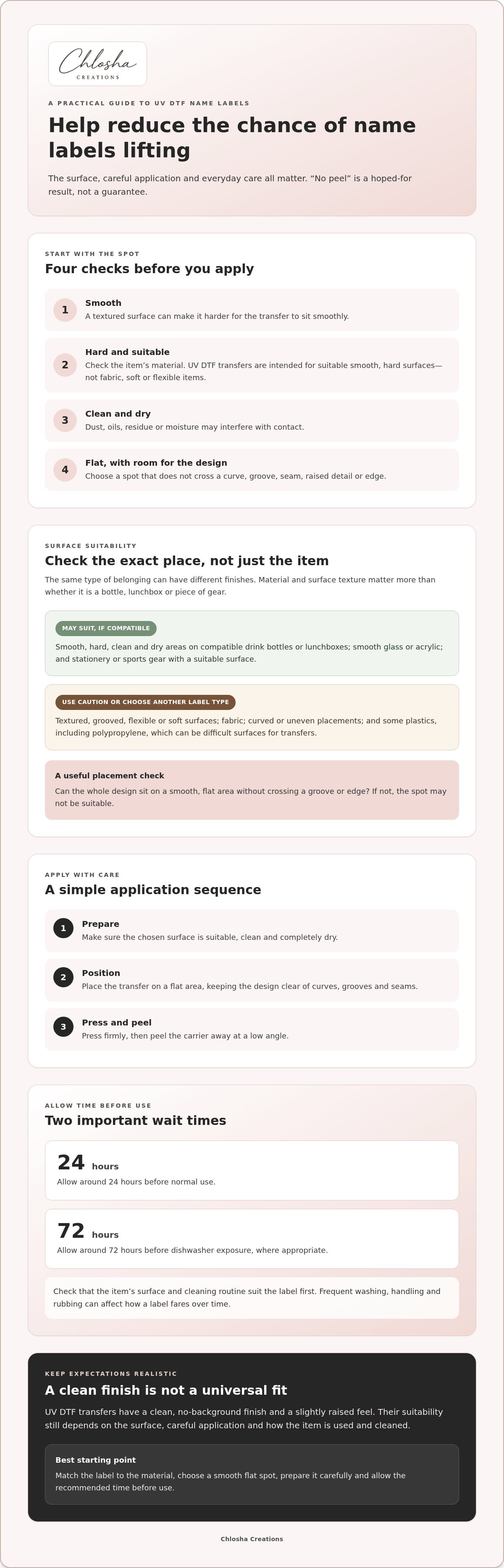
- For careful application, clean and dry the surface, position the transfer, press firmly and peel the carrier away at a low angle.
- Allow around 24 hours before normal use and around 72 hours before dishwasher exposure, where appropriate. Check that the item’s surface and cleaning routine suit the label first.
What “no peel” name labels can realistically mean
“No peel” describes the result you want, not a universal performance guarantee. Whether a label stays in place depends on the label, the item’s surface, how the transfer is applied and how the item is used and cleaned. Start by checking that the label is intended for the surface, rather than relying on an absolute claim.
Lifting can have several possible causes. Dust, oils or leftover moisture may interfere with contact, while texture can make it harder for a transfer to sit smoothly. Pressure and surface type also affect how many pressure-sensitive adhesives bond, as this general overview explains. That doesn’t identify why a particular label is lifting: the item and its surface need to be considered.
Why name labels may start lifting at the edges
Edges can be more vulnerable when they cross a curve, groove or raised detail instead of sitting on a smooth, flat area. Dirt or oils left behind after handling, or moisture on the item during application, may also affect the result. These are possible causes, not a diagnosis. Surface material, preparation and later care all matter.
What a no-background UV DTF name label looks like
A UV DTF name label has a clean finish without a visible background around the design, and it feels slightly raised. It’s made for suitable smooth, hard surfaces, such as compatible drink bottles, lunchboxes, glass or acrylic, not fabric. Textured, grooved, flexible or soft surfaces may not be suitable. Explore the personalised name labels guide to see options for belongings.
The appearance differs from labels made with other materials, so compare what each type is intended to stick to, how it’s applied and what care it needs. A neat, no-background finish doesn’t mean a transfer suits every item. For example, a smooth, hard section of a lunchbox may be a more suitable place than a textured lid or curved edge. Material matters too: some plastics, including polypropylene, can be difficult surfaces for transfers.
Before choosing a label, check the item and the intended spot. Is it smooth, hard, clean and dry? Is there enough flat space for the design without crossing a seam or groove? These checks help set realistic expectations for no peel name labels. A suitable surface and careful application are more useful guides than a promise that no label will ever lift.
How to choose no peel name labels for your child’s belongings
Start with the item, not the label. Check what it’s made from, whether the intended spot is smooth or textured, and how the item is likely to be cleaned. A drink bottle’s material and finish matter more than the fact that it’s a drink bottle. Even two lunchboxes can have different surfaces, so inspect the exact spot where you plan to put the name.
Next, compare the flat area with the label’s size. Choose a position where the design can sit without crossing a curve, groove, seam or edge. Think about everyday handling and cleaning, too. Areas that are often gripped or rubbed may be less practical placements, and frequent washing can affect how a label fares over time. For independent information on choosing products, you can also browse Consumer Reports’ product reviews; check that any advice applies to the item and label type you’re considering.
Which belongings suit UV DTF name labels?
UV DTF transfers are intended for clean, dry, smooth, hard surfaces. This may include a compatible drink bottle or lunchbox, or a smooth glass or acrylic item. School stationery and sports gear may also be options if the particular item has a suitable surface. The item’s category doesn’t determine suitability: a smooth, hard area may work, while a flexible or textured one may not.
| Belonging | What to check | Caution |
|---|---|---|
| Drink bottle or lunchbox | Smooth, hard, flat area | Avoid grooves, textured sections and unsuitable plastics |
| Glass or acrylic item | Clean, dry, smooth surface | Check the placement is flat enough for the design |
| Stationery or sports gear | Material and surface finish | Use only if the spot is smooth and hard |
| Fabric or flexible gear | Consider a label type intended for that material | Not suitable for UV DTF transfers |
When another label type may be more suitable
Fabric, soft or flexible items, textured areas, grooves and uncoated paper aren’t suitable surfaces for these UV DTF transfers. Silicone and polypropylene may also fail to provide a suitable bonding surface. Other label types are made for different materials and uses, so compare their intended surface, application method and care guidance instead of assuming one option suits everything.
For belongings with suitable smooth, hard surfaces, explore the personalised name labels and consider which size and placement will work best for each item.
UV DTF transfers and other name labels: compare the right features
Choosing between label types is less about finding one that’s always the most durable and more about matching the label to the item. Compare the finish, intended surface, application steps and care advice. A label suited to a smooth, hard lunchbox may not be right for a fabric school bag or flexible item.
UV DTF transfers have a clean, no-background finish, with the design feeling slightly raised on the surface. Other name labels may use different materials, have a visible backing, or be made for a different application method or surface. These differences can affect appearance and use, but they don’t make one type the best choice for every belonging.
What to compare before ordering name labels
Check the label’s product details before ordering, especially if the item will be washed often or handled throughout the school day. Look for clear guidance on suitable surfaces, application and care. Then check the item itself: is the intended area smooth and hard, or is it flexible, textured or grooved?
Placement matters, too. Choose a flat area with enough room for the design, away from seams, edges and spots that are repeatedly rubbed or gripped. Check the label dimensions against the available space, and choose a size that can sit flat without running onto an edge or curve.
How UV DTF differs from vinyl and other labels
“Vinyl” can refer to different products and applications, so don’t assume that all labels described that way look or perform alike. Compare the specific product information instead. Is the finish backed or no-background? Does it transfer onto a suitable hard surface, or is it intended for another material? What application steps and care limits does the maker provide?
Chlosha Creations’ UV DTF name labels are intended for suitable smooth, hard surfaces. They aren’t for fabric, flexible items or textured areas. No material suits every use, and don’t assume a label is waterproof or dishwasher-suitable unless its care guidance says so. For these transfers, allow around 24 hours before normal use and around 72 hours before dishwasher exposure, where appropriate.
Those checks are more useful than an unconditional “no peel” claim. If the item’s surface or cleaning routine doesn’t match the label guidance, consider a label type specifically intended for that use. For a suitable hard item, follow the transfer’s application directions closely and allow the recommended setting time before use.
How to apply name labels to help reduce peeling
Careful application can help a UV DTF transfer sit well, but it can’t make an unsuitable surface suitable or guarantee that a label won’t lift. Prepare the item first, then follow the instructions supplied with your label.
Prepare the surface and apply the transfer
Use this sequence for a suitable smooth, hard surface:
- Clean and dry: Remove dirt, oils and residue, then make sure the surface is completely dry. Grime or moisture can get in the way of a good application.
- Position first: Line up the design on a flat area, away from seams, grooves and edges. Check the placement before pressing, as moving it later may affect the application.
- Press firmly: Smooth the transfer down with firm, even pressure. Use a squeegee if the product instructions recommend one.
- Peel carefully: Ease the carrier away at a low angle rather than pulling it straight up. If part of the design doesn’t release, follow the supplied instructions before continuing.
A warm hair dryer on a low setting may help if needed. Don’t use heat as a substitute for checking surface suitability or following the application guidance.
Give the label time to settle and follow care guidance
After application, leave the item undisturbed while the transfer settles. Chlosha Creations recommends waiting around 24 hours before normal use and around 72 hours before dishwasher exposure, where appropriate. These are useful setting times, not a promise of dishwasher performance.
Dishwasher exposure depends on the surface, application and item’s care needs. A suitable surface and careful placement matter, but regular washing and handling can still affect how a label fares. If the item’s material or cleaning routine doesn’t match the product guidance, choose another option intended for that use. Check the bottle or lunchbox’s own care instructions as well.
These steps give your label a considered start, but “no peel” can’t be guaranteed, particularly on textured, flexible or otherwise unsuitable surfaces. If a smooth, hard item is a good match, you can explore personalised name labels and check the application guidance before choosing.
Find personalised no peel name labels suited to your items
Before choosing a label, check three things: the item’s surface, the available space and the application guidance. UV DTF transfers are intended for suitable smooth, hard surfaces. A flat spot on a drink bottle or lunchbox may be suitable, while a textured lid, flexible item or grooved area may not. “No peel” is a hoped-for result, not a guarantee, so matching the label to the surface is a practical first step.
Think about where your child needs their name most. School, kindy and daycare belongings might include drink bottles, lunchboxes, stationery and sports gear, but each item still needs an appropriate surface. Compare the flat area with the label size shown in the product details, leaving room around the design so it doesn’t cross an edge or curve.
Choose a label pack for the belongings you need to mark
Make a quick list of the items you want to identify, then consider how many labels you’ll need and whether different-sized designs would be useful. A larger name may suit a bottle, while a smaller one could fit a compact piece of stationery. Check the available pack details rather than assuming every size works for every item.
If a picture could help your child recognise their belongings, Personalised Icon + Name Label Packs pair a name with an illustration. This can provide a visual cue for younger children who are still getting familiar with their things.
Browse the range and check application details
Once you’ve identified belongings with suitable surfaces, look through Chlosha Creations’ personalised UV DTF name labels for school, kindy, daycare and everyday gear. Read the product details and surface guidance before choosing, then follow the application instructions and allow the recommended time for the transfer to settle. Results depend on the surface, application and care, so don’t assume a label suits every item or cleaning routine.
If you’ve found a smooth, hard spot and a useful size for your child’s belongings, you can explore personalised name labels and check which options fit your needs. Confirm the surface first, then choose a design and placement that make sense for the item.
Choose labels with confidence for everyday belongings
Choosing no peel name labels starts with the surface, not a promise on the packaging. Check that the spot is smooth, hard, clean and dry, then choose a size and placement that avoid grooves, seams and edges. The right fit and careful application can help reduce lifting, but no label is suited to every item.
Chlosha Creations’ personalised name labels use UV DTF transfers with a clean, no-background finish for suitable smooth, hard surfaces. They’re made for belongings used at school, kindy, daycare and beyond. Follow the application and care guidance, including waiting around 24 hours before normal use and around 72 hours before dishwasher exposure, where appropriate. Results depend on the surface, application and care.
Have an item in mind? Browse personalised name labels, check the surface guidance and choose an option that suits your child’s belongings. A thoughtful match is a practical start to keeping their everyday things easy to recognise.
Frequently Asked Questions
Can no peel name labels go on any drink bottle or lunchbox?
No. The item’s surface needs to suit the label. UV DTF name labels are intended for clean, dry, smooth, hard surfaces, so check the exact area where you plan to apply one. A flat section may be suitable, while a textured lid, groove or flexible surface may not be. The bottle or lunchbox material matters too, so check the product guidance before ordering.
Why do name labels peel off some surfaces?
Name labels may lift if the surface is textured, dirty, oily or damp during application. Curves, grooves and edges can also make it harder for a transfer to sit flat. Repeated handling and cleaning may affect how a label holds over time. Without knowing the item, its surface and how the label was applied and cared for, it isn’t possible to identify one specific cause.
How do I apply UV DTF name labels to help prevent lifting?
Start with a suitable smooth, hard surface. Clean it thoroughly and let it dry completely, then position the transfer carefully. Press firmly and evenly, using a squeegee if the product instructions recommend one. Peel the carrier away slowly at a low angle, following the supplied guidance. A warm hair dryer on a low setting may help if needed, but it isn’t essential or a substitute for checking the surface.
How long should I wait before using an item with a new label?
Allow around 24 hours before normal use so the transfer has time to settle. If the item may go in the dishwasher, wait around 72 hours before dishwasher exposure, where appropriate. These are recommended waiting times, not a guarantee of performance. How well a label holds also depends on the surface, careful application and ongoing care, so follow the product instructions for the specific item.
Can UV DTF name labels go in the dishwasher?
Dishwasher exposure may be appropriate for some labelled items, but don’t assume every label or item is dishwasher-suitable. Surface type and application affect the result, as can the item’s own care requirements. Follow the label guidance and wait around 72 hours before dishwasher exposure, where appropriate. If the item or its surface isn’t confirmed as suitable, hand-clean it according to the item’s care instructions.
Are UV DTF name labels suitable for fabric, silicone, or soft plastic?
No. UV DTF name labels are for suitable smooth, hard surfaces, not fabric, silicone or flexible and soft plastic. Textured or grooved areas, uncoated paper and some plastics, including polypropylene, may also be unsuitable. Check the material and finish of the exact spot before ordering. If the item is soft, flexible or textured, look for a label type specifically intended for that material.
What should I check before ordering no peel name labels in New Zealand?
Before ordering no peel name labels, check the item’s material, surface texture and cleaning routine. Confirm that the intended spot is smooth, hard and large enough for the label, then review the product’s application and care instructions. Consider how many belongings need names and whether different sizes would help. “No peel” describes a hoped-for outcome, not a universal guarantee, so match the label to the item.
