

Sibling Name Packs for Popular Pairings and Subtle Themes
A sibling set can feel connected without making every name match. The same is true of sibling name packs: choose a shared style, such as classic names like Emma and Theodore, while keeping each name distinct. A shared first initial can create a subtle link, but it doesn’t have to become a rule for every child.
It’s natural to want names that sound right together, especially when choosing a name for a new baby. The key is balance: a subtle connection can make names feel thoughtfully paired, while a narrow theme may feel too obvious over time. This guide explores sibling name combinations, from shared styles to gentle connections, and offers practical ways to avoid overly coordinated pairings. You’ll also find prompts for choosing names that feel right individually, not only side by side.
Key Takeaways
- Choose sibling names that share a broad style, then listen for whether they still sound distinct when said aloud.
- A subtle connection can come from a shared initial, similar meaning or naming style, without turning it into a rule for future children.
- Compare what a name pack includes before deciding if it suits your family’s needs and preferences.
- Think about where personalised labels will be used, such as school supplies, drink bottles or lunchboxes, when considering size and quantity.
- For children’s everyday items, match the label choice to the surface and follow the application and care guidance.
2. Popular sibling name combinations
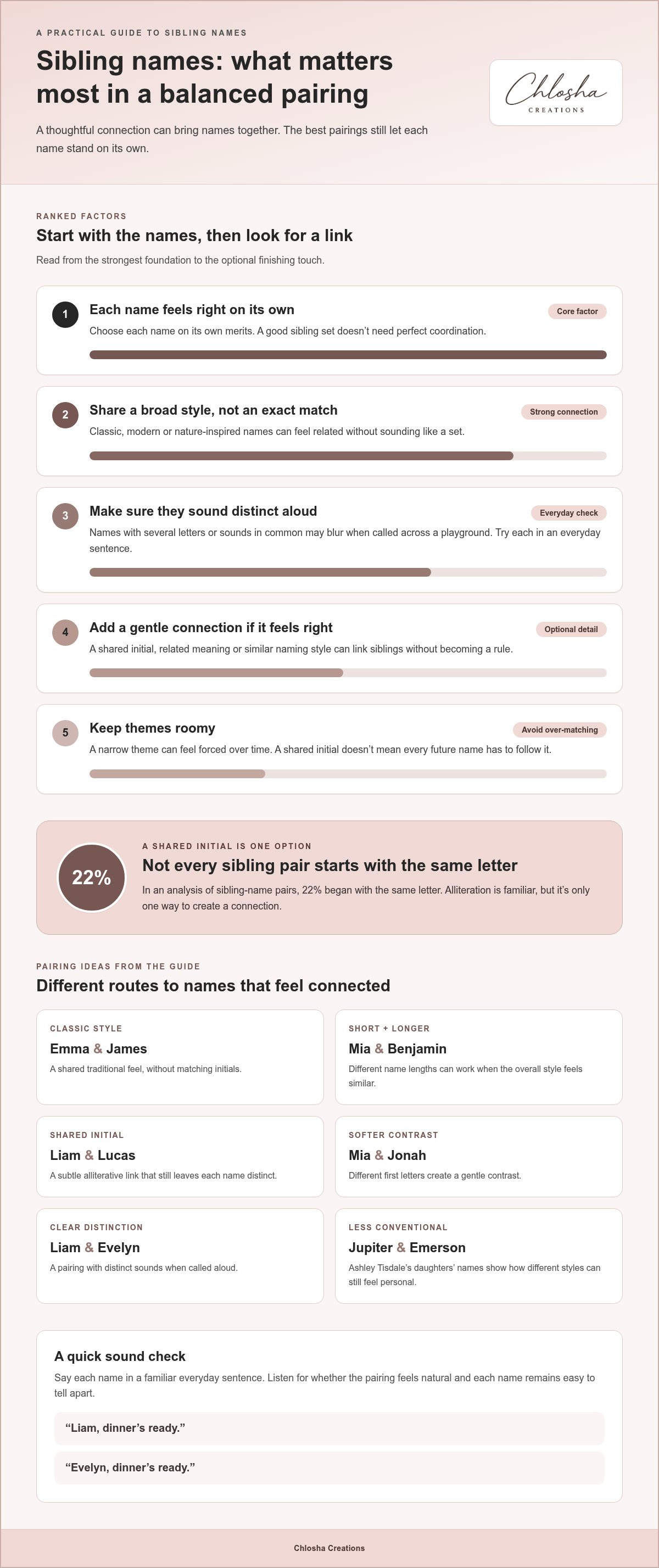
Popular sibling combinations often share a style rather than matching exactly. Try classic names such as Emma and James, or pair a short name with a longer one, such as Mia and Benjamin. Different lengths can work well together when both names feel traditional, modern or nature-inspired.
Sound offers another useful starting point. Four-letter names can make a balanced pair, while different first letters help each name keep its own identity. In an analysis of sibling-name pairs, 22% began with the same letter. That makes alliteration a familiar choice, but it’s only one option. Liam and Lucas share an initial; Mia and Jonah create a softer contrast.
Look beyond initials for a quieter connection. You might choose names with related meanings, such as two nature-inspired choices, or pick names from the same broad style. Classic names like Sophia and Eleanor feel related without sounding like a coordinated set. A short name beside a longer one can work too, as long as their overall feel is similar.
Distinct sounds matter. Names with several letters or sounds in common may blur when called across a playground. For example, two names with similar openings and endings may be harder to distinguish than Liam and Evelyn. Say each pairing aloud, then try it in an everyday sentence: “Liam, dinner’s ready” and “Evelyn, dinner’s ready.” How the names sound in daily use matters more than how they look together.
For a less conventional pairing, consider Jupiter and Emerson, the names of actor Ashley Tisdale’s two daughters. Their different styles show how a sibling set can feel personal without following one obvious pattern. A narrow theme, such as choosing every name from one fictional world, can feel forced. A broader idea leaves room for each child’s individual name.
A shared initial can be a sweet link, but choosing J names for two children doesn’t mean you have to continue the pattern. Choose each name on its own merits. Children spend much of their lives outside the sibling set, so a name that feels right individually matters more than perfect coordination.
These pairings can also inspire practical personalisation. For a visual link on children’s belongings, icon-and-name options give each child’s items a recognisable name and symbol, without requiring identical choices.
Colleen Slagen says four-letter names often work well together in a sibling set. Treat that as a starting point, not a requirement: consider whether each name feels right on its own before judging the pair. Say the names together and notice whether their shared length feels pleasing or too coordinated. If the match seems overly deliberate, try another kind of connection while keeping each choice distinct.
Colleen Slagen says short and long names can work together if they share a similar style. If one name feels compact and the other more expansive, focus on their overall character rather than matching their lengths. Say several combinations aloud, and keep the pairing that feels natural to use while letting both names stand on their own. A shared style can create a gentle link without making the names sound alike.
3. What names and customisation options are included in sibling name packs?
These sets bring children’s names together while leaving room for individual choices. Start by listing the names you want included, then check spelling, preferred forms and any middle-name details. For example, a family choosing Sophie and James might use the names they call the children every day, rather than adding full legal names automatically.
Some parents create a gentle link through meaning. Nature-inspired choices such as River and Willow share an idea without repeating the same sounds. A broader style works just as well: Emma and Eleanor have a classic feel, while Liam and Lucas share an initial. Use these as prompts, not rules for every family. Name sets can bring related choices together without making every detail identical.
Customisation can also help distinguish each child’s name. Consider matching lettering, different colours, a small symbol or a separate visual style for each sibling. For instance, the same simple type style could tie Sophie and James together, while a different icon beside each name makes belongings easier to tell apart.
Before choosing, make a short checklist for every name:
- Exact spelling: Write each name as it should appear, including accents or preferred shortened forms.
- Visual treatment: Decide whether names should share a colour and lettering style or have individual details.
- Personal symbol: Choose an icon that suits each child, such as a star for one and a leaf for another.
- Everyday readability: Consider whether a longer name, such as Theodore, needs a simpler design than Mia.
For a family with three children, consistency needn’t mean identical customisation. Rory, Janie and George could each have their own symbol while sharing a colour palette. That keeps the group recognisable and gives each name room to stand on its own. For two siblings, a shared icon may be enough; several matching details can make the set feel overly coordinated.
Think about where the names will be used before choosing details. A symbol can help a younger child recognise their drink bottle or lunchbox, while clear lettering helps adults identify school gear quickly. A long name may need more space than a short one, so choose a layout that keeps every letter legible.
If you’re comparing options, consider how a name and icon might help distinguish each child’s belongings. Icon and name label options offer one way to give each sibling’s items a clear, individual identity.
Colleen Slagen recommends choosing a unifying style, such as classic names, for a sibling set. She also cautions that names with several letters in common may sound too similar. Starting with two J names doesn’t mean every child has to have a J name. Her broader advice is not to focus too much on cohesion: children spend much of their lives apart from their siblings, and a name that feels right can be chosen even if it doesn’t match the others.
BabyCenter analysed names registered by families with two babies born between August 2020 and July 2024. This looks at naming choices in that specific group, alongside personal preferences and practical customisation decisions.
4. How much do sibling name packs cost in NZD?
The total depends on what a pack includes, how many names it covers and which customisation options are available. A set for two children may differ from one prepared for three. Compare the listed contents and final NZD total rather than judging by the pack name alone. Packs can include different combinations, so check the details for the option you’re considering.
First, confirm whether the displayed amount covers the whole set or applies to each child’s name. For example, a listing for Sophie and James might include both names, while another product could require a separate selection for each child. That distinction changes the total. Read the product description and check that it covers the number of names your family needs.
Next, compare the contents. One pack might include labels for drink bottles and lunchboxes, while another has a different mix or quantity. Check whether the listed amount is shared between siblings or provided for each name. If Sophie needs labels for school gear and James needs some for daycare belongings, compare each pack with that practical list.
Personalisation options can also affect what you’re comparing. A set with one shared design may differ from an option with separate icons or colours for each child. Look for any stated add-ons, and check whether the displayed NZD amount includes the choices you want. For instance, compare a matching design for Sophie and James with one that gives each child an individual symbol.
Use this checklist when reviewing options:
- Names covered: Confirm how many children the listed set includes.
- Contents: Check label types and quantities for each name.
- Design choices: See which colours, icons or layouts are included.
- Full total: Review the amount shown at checkout, including any delivery charge displayed.
A lower listed amount may cover fewer items or less personalisation. Compare like with like by checking each pack’s contents before deciding. For example, if one set includes labels for lunchboxes and drink bottles while another covers only one item type, the headline figures won’t show the full difference.
Finally, list what each child actually needs. A school pupil may use labels on several belongings, while a kindy child may need a different selection. Matching the set to those needs helps you weigh its total cost against its usefulness and avoid paying for options your family won’t use.
5. What sizes and quantities are available in sibling name packs?
The right size and quantity depend on which belongings need labels. A kindy child may need names for a drink bottle and lunchbox, while a school pupil may also need them for stationery or sports gear. Start with the items you have, then compare their surfaces and available space with the pack’s size details.
A name needs to fit the item and remain easy to read. A long name such as Theodore needs more room than Mia, especially if the design includes an icon. Check each label’s measurements, then compare them with a flat area on the bottle, lunchbox or container. Curved surfaces can make placement trickier, so measure the usable area rather than the item’s widest point.
Count what’s needed by child, item and spare. Write each sibling’s name beside the belongings that need identification. For example, Sophie may need a drink bottle label and a lunchbox label, while James also needs one for a sports bottle. This list shows whether the pack quantity suits your household or leaves an item uncovered.
Check whether the stated quantity is for the whole sibling set or for each name. A pack with names for Sophie and James may divide its contents between them. That differs from receiving the full listed quantity for each child. Read the product details carefully and compare them with your item list.
Use these steps to compare pack sizes and quantities:
- List belongings: Include each child’s drink bottle, lunchbox and commonly mixed-up gear.
- Measure placement areas: Use a ruler on the flattest available section of each item.
- Count needed labels: Give each item a clear name label, then consider whether spares would be useful.
- Compare name layouts: Check that longer names such as Theodore remain legible within the stated dimensions.
Think about how your family uses its gear. If siblings share storage space, clear names on similar lunchboxes can make belongings easier to identify. If each child carries different equipment, prioritise labels for items that travel between school, daycare, kindy and home.
Before ordering, compare the label dimensions with the item. A small flat area on a drink bottle may suit a compact design, while a broad lunchbox lid can accommodate a larger one. Match the quantity to your list rather than guessing how many labels a family usually needs.
5. What materials are sibling name packs made from, and are they safe for children
Materials and suitable uses depend on the product, so check the item description before choosing a pack. A name label for a drink bottle is different from a name tag or paper insert. A material name alone doesn’t show whether an item suits every child or use.
Some personalised labels use UV DTF transfer technology. UV DTF describes a transfer method, not a complete materials list or a child-safety rating. Check the product details for intended surfaces and application instructions. A clean, smooth, no-background finish describes the appearance, but doesn’t answer questions about composition or suitability.
Consider where each label will go. Drink bottles, lunchboxes and pencil cases have different surfaces and uses. Keep labels away from a bottle’s drinking rim, the inside of a lunchbox and any area that touches food. Follow the application directions for the specific item rather than assuming every surface is suitable.
Child safety also depends on how an item is used. An outside lunchbox label is different from a loose piece of transfer material within reach. An adult can apply the label and keep unused pieces and packaging out of young children’s reach. Don’t leave small loose pieces where a child could mouth or swallow them.
Before buying, use this practical check:
- Identify the material: Read the product details for the label or tag, rather than relying on the word “personalised”.
- Check the intended use: Match the stated surface to an example, such as a hard-sided drink bottle or lunchbox.
- Choose a suitable position: Keep a label clear of food-contact areas and bottle openings.
- Apply with care: An adult should handle loose pieces and follow the stated application steps.
- Clean thoughtfully: Hand wash labelled drink bottles and lunchboxes. The result can depend on the surface, correct application, curing time, washing conditions and ongoing use.
When comparing two packs, ask the same questions about each: does the product name its material, intended surfaces and care instructions? A detailed description helps you understand what you’re applying to a child’s belongings. A material label alone cannot establish that a product is safe for every age, surface or use.
Keep the finished item under adult supervision if a child is very young or tends to chew belongings. For a bottle, check the label’s placement during regular cleaning. These steps help families use personalised items thoughtfully, without treating a decorative label as a toy or food-contact material.
Chlosha Creations: Personalised Name Labels
Chlosha Creations makes personalised name labels to help families identify children’s everyday belongings. If you’re preparing drink bottles, lunchboxes or school supplies for siblings, choose individual names so each child’s gear is easy to recognise.
Personalised Icon + Name Labels add a symbol beside each name, giving siblings a simple visual distinction. Kids Name Labels and School Name Labels offer practical options for family and school use. The labels use UV DTF transfers, with a clean, smooth, no-background finish on suitable items.
Ready to organise your children’s belongings with names that suit each one? Explore Chlosha Creations online and browse the personalised name label options.
Make each child’s everyday gear their own
Picture a regular weekday: two drink bottles on the bench, lunchboxes packed for school and sports gear ready by the door. Which belongings are easiest to mix up? Start with those. Sibling name packs help you plan a coordinated approach while keeping each child’s name clear on their own label.
Consider what will help each child recognise their belongings. Personalised Name Labels keep the focus on names, while Personalised Icon + Name Labels add a visual cue. Kids Name Labels are another option for everyday items. Choose a style that suits your family’s routine rather than making every item look identical.
Once you’ve decided what to label, explore personalised name label options for siblings. A thoughtful choice can make everyday gear easier to identify and help each child feel connected to their own belongings.
Frequently Asked Questions
What are sibling name packs?
Sibling name packs group personalised labels for children in the same family. Each child’s name can identify their own belongings, such as a school drink bottle, lunchbox or stationery case. For example, a pack for Alex and Sam can help distinguish two similar drink bottles. Check the product details to see which label types and quantities are included.
