

Social Media Handle Decals for Products: NZ Buying Guide
The neatest-looking social media handle decal isn’t always the smallest one. Social media handle decals for products need to be easy to spot and read without crowding your branding or getting lost on the surface.
If you’re unsure which format will suit your products, or whether a small handle will be readable at a glance, you’re not alone. The right choice depends on where the decal sits, how customers view the item and what the surface is made of.
This guide explains how to choose a suitable decal format and placement, size your handle for clear reading, and understand practical application and care. You’ll also learn where a clean, no-background UV DTF transfer may work well and which surfaces are unsuitable, including textured, flexible or soft plastics. A few thoughtful choices can give your product a polished finish and make it easier for customers to find you online.
Key Takeaways
- Choose social media handle decals for products by checking the surface, measuring the available space and confirming the artwork before deciding on placement.
- Compare a handle-only layout with logo-and-handle artwork to balance readability, space and brand consistency.
- Prioritise a clear, readable handle that customers can spot from the product’s usual viewing distance.
- For UV DTF transfers, use a clean, dry, smooth hard surface and follow the application and care guidance for the specific item.
- Before choosing a supplier, check surface compatibility, artwork requirements and practical care advice for your product range.
Why add social media handle decals to products?
A social media handle decal puts your business account name directly on a product, giving customers a simple way to find your profile after taking the item home. A decal is an applied design or marking; see What is a decal? for a broader overview. For product branding, the aim is simple: make your account easier to find without letting promotion take over the design.
A handle on the product works differently from a packaging insert or promotional card. The product carries the account name, while an insert gives you more room for extra details, a QR code or a personal message. Both can have a place in the customer experience. Choose based on the item, the space available and how you want the information to be seen.
A handle decal is useful when there’s a suitable spot on the product where customers can read the account name without disrupting its design.
Which businesses and products might benefit?
A maker selling drinkware could add a small handle to a suitable smooth, hard surface. Market sellers might use one on a product customers can keep or reuse, while a small business could add a branded detail to a suitable hard surface. In each case, the physical item connects customers with the business online, but the decal needs enough space for clear text. Check the surface first: UV DTF transfers are intended for clean, dry, smooth hard surfaces, not textured or grooved areas, silicone, flexible or soft plastic, fabric, uncoated paper or polypropylene.
What should a handle decal communicate?
Start with the exact account handle. Check every letter, full stop, underscore and capital letter against the live profile before approving the artwork. A small typo can make the account harder to locate, so proofread it carefully.
If the handle doesn’t make your business obvious, a short brand name may help customers connect the profile with the product. Keep the layout uncluttered: extra text can make both the name and handle harder to read. These social media handle decals for products can point customers towards your online identity, but they can’t guarantee follows, sales or engagement. Clear wording and thoughtful placement simply make the next step easier to understand.
How to choose social media handle decals for products
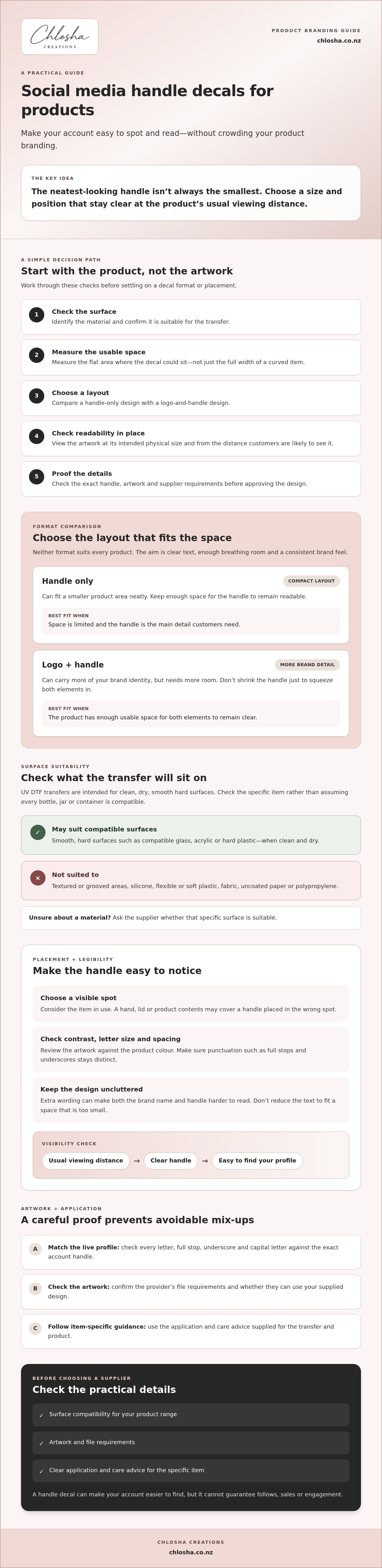
Start with the product, not the artwork. Identify the surface, measure the usable space, check the artwork, then choose a placement that stays visible during normal use. This order helps you avoid a design that looks tidy on screen but is too small or unsuitable once it’s on the item.
Check the product surface before choosing a decal
UV DTF transfers suit clean, dry, smooth hard surfaces, such as compatible glass, acrylic or hard plastic. They aren’t suited to textured or grooved areas, silicone, flexible or soft plastic, fabric, uncoated paper or polypropylene. Check the material of the specific item rather than assuming every drink bottle, jar or container is compatible. If you’re unsure, ask the supplier whether the surface is suitable.
Measure the space and choose a layout
Measure the flat area where the decal could sit, then consider how much space the handle needs to remain readable. A handle-only layout can fit compact products neatly. A logo-and-handle layout can carry more of your brand identity, but needs more room and shouldn’t make the text harder to read. Neither format suits every product.
Consider the item in use, too. A handle placed where a hand, lid or product contents regularly cover it may be less visible. On a curved item, the useful viewing area can feel narrower than its full measured width.
Check legibility and artwork before ordering
Contrast, letter size and spacing all affect how easily customers can read a handle. Check the design against the product colour, and make sure punctuation such as full stops and underscores remains distinct. Don’t shrink the text to squeeze it into a space that’s too small. View the artwork at its intended physical size and from the distance customers are likely to see the product.
Before supplying artwork, check the provider’s file requirements and confirm whether they can use your supplied design. If a decal includes product information as well as a social handle, review the relevant NZ product information standards to understand what may apply.
For a related look at how decals can support a wider brand identity, explore a guide to branding decals for small businesses. Keep the same handle, spelling and visual style across your product range for a consistent finish.
Compare decal formats, placement and product fit
The best format depends on the product’s shape, the space available and where customers are likely to notice the handle. A small item may suit simple text, while a larger, flatter area can give a logo and handle room to breathe. Packaging is another option if the product has no suitable surface.
| Format | Readability and space | Brand consistency | Application needs |
|---|---|---|---|
| Handle-only text | Uses less space; can be clear on compact products if the lettering remains large enough. | Works neatly alongside existing branding, though it may carry less visual identity on its own. | Must suit the product surface and stay visible in normal use. |
| Logo plus handle | Needs more room. Both elements should remain distinct and easy to read. | Can bring the product closer to your wider brand look when type and colours are consistent. | Artwork needs enough clear space, plus a suitable surface and placement. |
| Packaging or insert | Offers room for a longer message or extra details without using product space. | Can follow the same brand style, but the information is separate from the item. | Applied to packaging or included with it, rather than directly to the product. |
Handle-only or logo-and-handle artwork?
Handle-only artwork can work well in a narrow area, provided the text isn’t reduced until it becomes difficult to read. Add a logo when there’s room for both elements to stand apart. Use consistent type and colour choices across products, and check the final artwork at its intended size before approving it.
Product decal or packaging message?
A product decal keeps the account details with the item, but the surface needs to suit the format and the item’s everyday handling and cleaning routine. Packaging or an insert may be a better fit if the item is textured, curved, frequently washed or has little clear space. Consider where customers are most likely to see the information, and choose a placement that won’t be covered by a hand, lid or another part of the product.
Different decal materials and transfer methods have their own application requirements, so no one format is automatically best for every product. For UV DTF, read a fuller guide to the transfer method alongside the supplier’s surface and care advice. Utah State University Extension also offers general product labelling basics; it’s an educational resource, not New Zealand-specific regulatory guidance. Use these points to compare social media handle decals for products with a packaging message before choosing a format.
Prepare, apply and care for custom handle decals
Careful application helps a UV DTF transfer settle neatly. Follow the instructions supplied with your transfer, as application can vary by product and surface. These transfers are intended for clean, dry, smooth hard surfaces. Textured or grooved areas, silicone, flexible or soft plastic, fabric, uncoated paper and polypropylene aren’t suitable.
Application steps for a smooth, clean finish
- Clean and dry: Remove dirt and residue from the chosen area, then let it dry fully. Don’t apply the transfer over moisture or grime.
- Position first: Check the placement before applying. Make sure the handle will be visible and the design sits neatly on the surface.
- Press firmly: Smooth or squeegee across the design to press it onto the item.
- Peel slowly: Pull the carrier back at a low angle. If part of the design lifts with it, lay the carrier back down and press that area again before continuing.
A warm hair dryer on a low setting can help if needed. Use gentle warmth and follow the supplier’s directions. Don’t assume the same approach suits every item, especially if you’re unsure how its surface responds to heat.
Set realistic expectations for everyday care
Allow approximately 24 hours before normal use so the transfer has time to settle. Where dishwasher exposure is appropriate for the item and transfer, wait approximately 72 hours first. This doesn’t mean every product can go through a dishwasher. Check the supplier’s care guidance and consider hand washing if you want to be cautious.
How a transfer holds up depends on surface compatibility, correct application and curing time. Frequent washing, handling and the item’s shape can also affect everyday wear. Avoid describing any decal as permanently waterproof, indestructible or dishwasher-proof.
For a custom handle, check the artwork, surface and application guidance before ordering. Chlosha Creations offers custom UV DTF printing and Business Logo Transfers for suitable smooth hard surfaces. If you’re also labelling children’s belongings, explore the range of personalised name labels.
Choosing a custom decal supplier for your product range
A suitable supplier should help you match the artwork and transfer to the item, not simply take a handle and print it. Before ordering social media handle decals for products, check that the material, design size and intended use are a good fit. Clear advice up front can help you avoid a decal that’s difficult to apply or read.
Questions to ask before placing a custom order
Use this checklist to cover the practical details:
- Is my product surface suitable? Share the item’s material and ask whether the transfer is appropriate. UV DTF transfers are for suitable smooth hard surfaces, not fabric, soft goods, silicone or flexible and soft plastics.
- What artwork can you accept? Confirm accepted file formats, dimensions and any design preparation requirements. Check whether your supplied handle artwork can be used rather than assuming it can.
- Will the design be clear at its final size? Ask how to check lettering, spacing and contrast before production, especially if the handle includes punctuation or needs to fit a compact area.
- What are the application and care instructions? Make sure you understand how to prepare the surface, apply the transfer, allow it to cure and care for the item during everyday use.
Useful guidance should relate to your actual product. A smooth, hard container and a flexible pouch need different solutions, so provide accurate material details and explain how the item will be handled or cleaned.
Explore suitable personalisation options
Chlosha Creations offers custom UV DTF printing and Business Logo Transfers for compatible hard surfaces. The transfers create a clean, no-background finish with a slightly raised effect. They aren’t intended for fabric or soft goods, and how they perform depends on surface suitability, correct application and curing time. Check the artwork requirements and intended use before ordering.
If you’re comparing product personalisation for your wider range, explore Chlosha’s custom printing and branding options and check which surface types are suitable. For a different need, such as identifying drink bottles or lunchboxes, you can also explore personalised name labels. This collection is for name labels, not a dedicated social media handle decal listing.
Make your product branding easy to find
The right handle decal is clear, well placed and suited to the product surface. Before ordering, check the material, measure the available space and review the artwork at its intended size. A simple handle may be easier to read on a compact item, while a logo-and-handle layout can work where there’s room for both.
For social media handle decals for products, application and care matter too. Use a suitable surface, follow the supplier’s instructions and allow the recommended curing time. Durability depends on the surface, correct application and how the item is used.
Chlosha Creations offers custom UV DTF printing and Business Logo Transfers for suitable smooth hard surfaces. The transfers have a clean, no-background finish with a slightly raised effect. They’re not designed for fabric or soft goods, so check material compatibility before exploring this option.
If you’re looking for a different kind of personalisation for drink bottles, lunchboxes or belongings, you can explore personalised name labels. Take your time choosing what fits your product and brand, then explore Chlosha Creations’ custom UV DTF printing and Business Logo Transfers for suitable surfaces.
Frequently Asked Questions
Can I put a social media handle decal on any product?
No, a decal won’t suit every product. For UV DTF transfers, the item needs a clean, dry, smooth hard surface that’s compatible with the transfer. Textured or grooved areas, silicone, flexible or soft plastic, fabric, uncoated paper and polypropylene aren’t suitable. Check the material of the specific product before ordering, as bottles and containers can be made from different materials.
What surfaces are suitable for custom UV DTF handle decals?
Suitable options can include compatible glass, acrylic and hard plastic, provided the surface is smooth, clean and dry. A product’s material name alone doesn’t confirm that its finish is suitable, so check the exact item with your supplier. Avoid textured or grooved surfaces, silicone, flexible or soft plastic, fabric, uncoated paper and polypropylene. Surface compatibility affects how the transfer applies and performs.
How do I make a social media handle easy to read on a product?
Use clear lettering with enough size, spacing and contrast against the product colour. Check the handle spelling, full stops and underscores, then view the artwork at its intended size and from the distance customers will usually see the item. Keep the layout simple, especially on a curved or compact product. Don’t shrink the text to force it into a space that’s too small.
Are UV DTF handle decals the same as vinyl stickers?
No. UV DTF describes a transfer printing method, while vinyl stickers are a different product category. Materials, finishes and application steps can vary between products and suppliers, so compare the specific guidance rather than assuming they’ll perform alike. Chlosha’s UV DTF transfers have a clean, no-background finish with a slightly raised effect and are made for suitable smooth hard surfaces.
How long should I wait before using a product with a new decal?
Allow approximately 24 hours before normal use so the transfer has time to settle. Follow the supplier’s application and curing guidance for the particular product, and avoid handling or washing the area during this time if the instructions advise it. How well a transfer performs depends on surface compatibility, correct application and curing time, so the wait period doesn’t guarantee the same result on every item.
Can products with UV DTF decals go in the dishwasher?
Don’t assume every product with a UV DTF decal is suitable for dishwasher use. Where dishwasher exposure is appropriate, wait approximately 72 hours before placing the item in the dishwasher, and follow the supplier’s care guidance. The result can depend on the surface, application and curing time, as well as the item’s use. Avoid describing a transfer as dishwasher-proof or treating dishwasher exposure as suitable for every product.
Can I order a custom business logo transfer with a social media handle?
Chlosha Creations offers custom UV DTF printing and Business Logo Transfers, but confirm before ordering whether your supplied handle artwork can be used. Ask about accepted file formats, dimensions and design preparation requirements, and provide the product material so surface suitability can be checked. These transfers are intended for suitable smooth hard surfaces, not fabric or soft goods. Performance depends on correct application and curing time.
