

Starting School Checklist NZ: A Practical Guide for Families
A starting school checklist NZ families can use should make the first day feel more manageable, not add another thing to worry about. Getting ready can be less about buying everything at once and more about taking a few small steps together.
It’s normal to wonder what your child needs, which school requirements matter and how to help them feel settled. Every school has its own details, so start with its latest information. Then organise essentials in stages and practise simple routines at home.
This guide brings those preparations together in one practical plan. You’ll find ways to check enrolment and school-specific requirements, gather everyday belongings and help your child feel more familiar with what’s ahead. We’ll also cover identifying suitable items such as drink bottles and lunchboxes, plus gentle steps to build confidence before the first day. Start with what your school asks for, then work through the rest at a pace that suits your whānau.
Key Takeaways
- Use the starting school checklist NZ families need as a flexible plan, and follow your school’s current information for requirements.
- Break preparations into smaller steps so you can organise essentials gradually instead of leaving everything until the last minute.
- Practise everyday routines and encourage your child to communicate their needs, without treating readiness as a pass-or-fail test.
- Prepare for the first day and the first week with a simple plan for the evening before, the morning and the after-school check-in.
- Use clear name labels to help identify suitable smooth, hard-surface belongings such as compatible drink bottles and lunchboxes.
Starting school in New Zealand: what to organise first
There’s no single checklist that suits every child or school. A kura’s routines, uniform expectations and learning supplies can differ, so begin with the information sent directly to your whānau. You don’t need to have every detail sorted at once. Separate early planning from first-day preparation to give yourself time to ask questions, gather what’s needed and help your child get familiar with the change.
For background on how primary and secondary schooling fit into the wider system, see this overview of Education in New Zealand. For details that affect your child’s start, your school or kura is the best guide.
Confirm the school or kura details
Check the enrolment information and note your child’s confirmed start date, arrival time, where to go on the first morning and who will meet them. Look out for updates through the school’s usual communication channels, such as its website, email or parent app. If you haven’t received these details, contact the school office and ask where to find the latest new-student information.
Uniform, stationery and equipment lists can vary. One school may ask whānau to provide particular learning materials, while another may supply some items. Sun protection, spare clothes and other everyday gear can also depend on the school’s routines. Note who to contact if an instruction is unclear, such as the school office or your child’s classroom teacher. This can help you resolve questions before buying or packing something unnecessary.
Your school’s own information should guide the final checklist. Keep it handy and use it to distinguish what’s required from what’s simply useful.
Make a simple preparation timeline
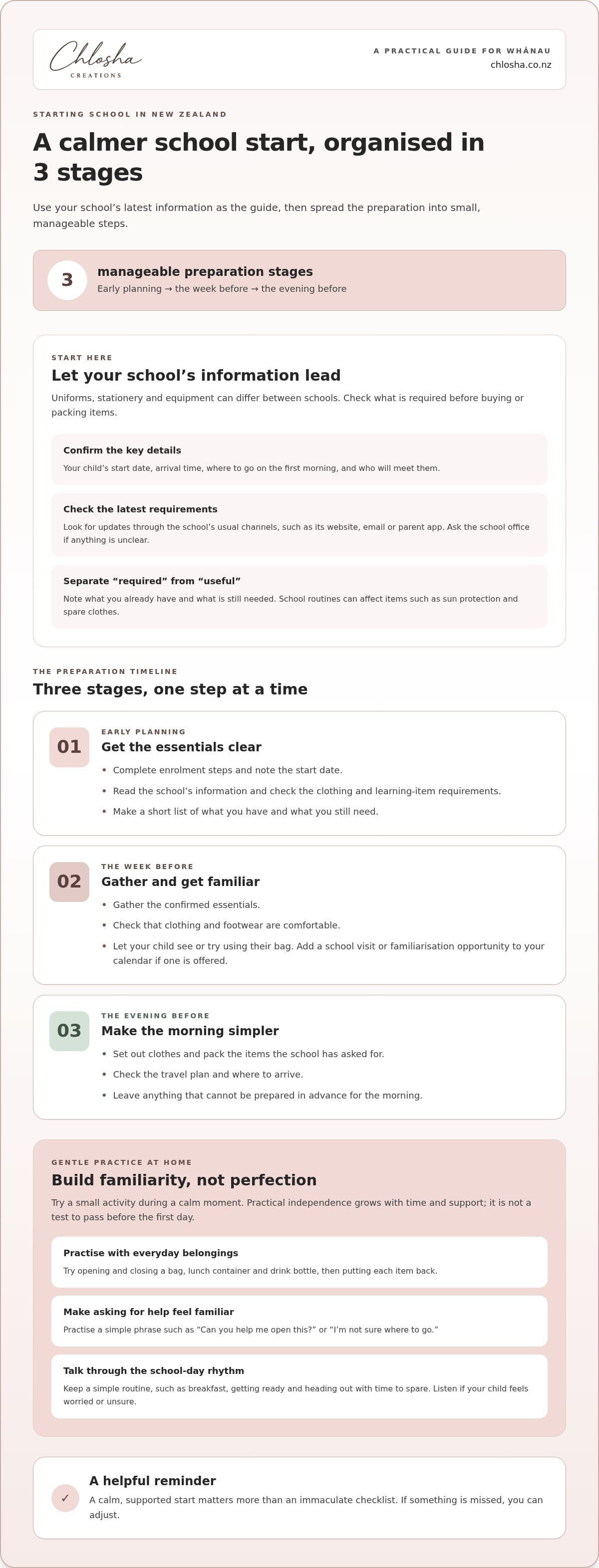
A starting school checklist NZ families can actually use spreads tasks across a few manageable stages. You don’t need to shop, practise and plan everything in one weekend. Try grouping the jobs like this:
- Early planning: Complete enrolment steps, note the start date and read the school’s information. Check what clothing and learning items are required, then make a short list of what you already have and what’s still needed.
- The week before: Gather the confirmed essentials, check that clothing and footwear are comfortable, and let your child see or try using their bag. If the school offers a visit or familiarisation opportunity, add it to your calendar.
- The evening before: Set out the clothes and pack the items the school has asked for. Check the travel plan and where to arrive, then leave anything that can’t be prepared in advance for the morning.
Spread small purchases and practice across ordinary moments. Your child might help choose where their bag sits at home or practise opening their lunchbox. These steps build familiarity, not perfection. If you miss something, you can adjust. A calm, supported start matters more than an immaculate checklist.
Build the everyday skills and routines that help tamariki settle
Starting school readiness isn’t about arriving able to do everything alone. Practical independence helps, but so does being able to share a need, listen to instructions and feel safe asking an adult for help. These abilities grow with time and support. Use your starting school checklist NZ as a prompt for gentle practice, not a test your child has to pass before their first day.
Helpful practice gives tamariki a little more familiarity; it doesn’t mean they need to arrive fully independent. Teachers and other adults at school can support children as they learn new routines. For broader guidance about schooling and preparation, the New Zealand Government information on school and college is a useful reference.
Practise everyday independence without pressure
Let your child try manageable tasks with you nearby. The aim is to make everyday school items feel less unfamiliar, not to get every attempt right. Try one small activity during a calm moment, then repeat it another day if it’s useful.
- Let them open and close their bag, lunch container and drink bottle, then practise putting each item back.
- Invite them to find their belongings among a few familiar items, or carry their bag from the door to the car.
- Practise a simple phrase for asking for help, such as “Can you help me open this?” or “I’m not sure where to go.”
Keep the language encouraging: “Let’s try it together” is more reassuring than stepping in straight away or expecting them to manage alone. Clear names on compatible belongings can also give children a helpful visual cue as they learn what’s theirs. For smooth, hard-surface items such as a drink bottle or lunchbox, explore personalised name labels as one way to identify them.
Make the school-day rhythm feel familiar
A predictable morning can feel easier when parts of it are already familiar. Practise getting dressed, having breakfast and gathering what your child needs, without trying to recreate a perfect school morning. If dressing takes time, let them choose between two suitable options or practise a tricky button during a relaxed moment.
- Role-play a greeting, taking turns in a conversation or joining a game. Keep it light and let your child swap roles with you.
- Talk through what might happen at drop-off, then ask what they’re curious or unsure about.
- Make space for feelings. If they say they’re worried, listen and acknowledge it rather than brushing it aside with “You’ll be fine”.
A small routine can be enough: breakfast, getting ready, then heading out with time to spare. Children may feel excited one day and uncertain the next. Keep conversations open, answer questions simply and remind them which trusted adults they can turn to at school. Confidence grows through connection and practice, one ordinary moment at a time.
Use this school-starting checklist for clothes, kai and gear
A useful starting school checklist NZ families can adapt begins with the school’s current instructions. Uniforms, stationery and everyday equipment aren’t the same everywhere, so use this as a prompt for what to check, not a universal shopping list. The school’s list takes priority over a generic starting-school checklist. Before buying or packing an item, make sure it’s requested or suitable for your child’s school day.
As you gather things, invite your child to try them out. Can they carry the bag comfortably, open their lunchbox and drink from their bottle? A quick practice at home can show you if a zip is tricky or a container needs a different kind of opening.
Check clothing and personal essentials
Use the school’s uniform guidance rather than assuming every school has the same dress code. Check that the clothes and footwear your child will wear are comfortable, fit well and are manageable for them to put on. Try fastenings and shoes in advance, especially if they’re new.
- Uniform or school clothing: Follow the school’s requirements, including any guidance on colours, footwear or required items.
- Sun protection: A hat or other items may be required or recommended by the school. Check its current policy.
- Spare clothes and personal-care items: Pack these if the school asks for them or gives your child specific instructions about what to keep in their bag.
Keep the first-day outfit simple and comfortable. If something feels awkward during a quick try-on, sort it before the school morning if you can.
Pack lunch, drink bottle and school gear
Follow the school’s guidance on kai, snacks and any belongings that need to stay there. Some learning items may be supplied or shared, while others may be listed for families to bring. Use the school’s stationery and equipment list to decide what goes into the bag.
- Bag: Check that your child can carry it and reach the main compartment. Pack only what the school has asked them to bring.
- Lunchbox and kai: Choose a container your child can open and close, then practise packing and unpacking it together.
- Drink bottle: Make sure your child can open it, take a drink and close it again without help.
- Learning items: Add the stationery or other equipment named by the school, rather than guessing what might be needed.
- Other requested gear: Check whether the school has instructions for items such as sports gear or belongings that stay on site.
Clear names can help identify compatible belongings, such as suitable smooth, hard-surface drink bottles and lunchboxes. Explore personalised school name labels for these items. Apply them to a clean, dry surface and hand wash labelled drink bottles and lunchboxes.
Prepare for the first day and the first week, not just the photo
The first morning is only one part of starting school. A little planning can make it easier to leave home, while a flexible approach gives your child and whānau room to settle into the new rhythm. If the school offers a visit or familiarisation opportunity, consider going along. Seeing the classroom, meeting a teacher or finding out where to arrive can make the setting feel less new.
The evening-before and morning checklist
Keep the final preparations short and familiar. Use the school’s list, follow your usual family routine where you can, and leave time for a reassuring chat instead of adding extra jobs at the last minute.
- The evening before: Pack the bag with the items the school has requested and put it somewhere easy to find. Set out the clothes and footwear, and prepare any lunch items that fit your normal routine.
- In the morning: Allow enough time to get ready, have breakfast and travel without rushing. Give your child a simple reminder of what will happen next, such as getting to school, saying goodbye and meeting their teacher.
- At drop-off: Keep your goodbye warm and calm. Follow the school’s arrival arrangements, say when you’ll see your child again in clear, reassuring words, then let the school staff support the transition.
- After school: Make space to reconnect before asking about the day. Offer a snack or a quiet moment if that suits your child, then invite them to share anything they’d like.
If you’re preparing named belongings for the school day, you can explore personalised name labels for compatible smooth, hard-surface items. It’s one small job to sort ahead, leaving the evening focused on your family’s routine.
Support the transition after school starts
Children don’t always give a full account straight away. Try open, low-pressure questions such as “What was something you enjoyed?” or “Was anything tricky today?” If they’re not ready to talk, let them know you’re available later. Listening without pressing for details helps them share in their own time.
Notice what your child’s experience tells you about the routine. If mornings feel rushed, put one more thing by the door the night before. If the bag is hard to manage, practise carrying it at home or review what’s packed against the school’s instructions. Small adjustments can make the next day more workable for everyone.
Settling in can take time, and each child’s experience will be different. Some may be eager to talk, while others need a quieter afternoon or a few days to get used to the change. Treat your starting school checklist NZ as a flexible guide, not a standard your whānau must meet perfectly. Keep checking in, follow the school’s communication and adjust the first-week routine as you learn what helps your child feel secure.
Keep school belongings organised with clear name labels
Names can make it easier for tamariki and adults to spot whose belongings are whose during everyday school routines. For your starting school checklist NZ, begin with a few items your child uses often, rather than trying to label everything at once. Compatible drink bottles and lunchboxes are practical options if they have a clean, dry, smooth, hard surface.
UV DTF name labels are for suitable hard surfaces, not clothing or fabric. Textured, flexible or soft materials aren’t suitable. Check the item’s surface before applying a label. The clean, smooth, no-background finish makes a name easy to see on compatible belongings.
Choose belongings that suit name labels
Start with items that travel between home and school most often, such as a drink bottle and lunchbox. Check that the area you plan to label is smooth and flat enough for the transfer, and avoid seams, curves or textured sections. For children who enjoy a picture alongside their name, Personalised Icon + Name Label Packs offer themed designs for school belongings.
Apply labels carefully and allow time to settle
Take your time with application so the label sits neatly on a clean surface. Follow the supplied guidance and avoid rushing the process just before the first school morning.
- Clean the chosen area and let it dry fully. Make sure it’s free from dust, oil and moisture.
- Position the label carefully before applying it, as moving it after placement may affect the result.
- Press firmly across the design, then peel the carrier back at a low angle, slowly and steadily.
- If needed during application, use a warm hair dryer on a low setting. Avoid overheating the item or label.
- Leave the label for about 24 hours before normal use. If the item may be exposed to a dishwasher, allow about 72 hours first, but hand washing is recommended.
Care and durability can depend on the surface, correct application, time allowed to settle, washing conditions and ongoing use. Don’t assume a labelled item is dishwasher- or microwave-safe. Hand wash drink bottles and lunchboxes, and follow the item maker’s care instructions.
A few clearly named belongings can make packing and unpacking more straightforward as your child gets used to school routines. If you’re organising compatible hard-surface items, take a look at the personalised name labels collection and choose labels that suit what you plan to identify.
Take the next small step towards school
Your starting school checklist NZ doesn’t need to be completed all at once. Choose one practical task for your whānau to do next, then leave the rest for another day. A settled start is built from familiar routines and thoughtful preparation, not from getting every detail perfect before the first morning.
For smooth, hard-surface belongings, Chlosha Creations Personalised Name Labels and Personalised Icon + Name Label Packs offer options for children’s school items. The premium UV DTF transfers have a clean, no-background finish and are intended for suitable smooth surfaces.
Explore personalised name labels for school belongings when you’re ready to organise a few everyday essentials. One step at a time, you and your tamariki can head into this new chapter feeling more prepared.
Frequently Asked Questions
Does my child need to know how to read before starting school?
No, there isn’t one reading level every child must reach before starting school. Tamariki arrive with different experiences, interests and strengths, and learning continues in the classroom. Keep books part of enjoyable family time: share a story, talk about a character or let your child choose what to read together. There’s no need to test them. If you have a specific concern about your child’s learning, raise it with the school or kura.
What should I ask the school before my child starts?
Ask how the school prefers whānau to share important updates, such as a change to collection plans or an absence. Find out which staff member or office is the right first contact, and how to pass on information that may help your child during the day. You could also ask what happens if you arrive late. Knowing these everyday processes can make the first weeks more straightforward for the whole whānau.
Can my child visit their school before the first day?
Some schools offer visits or transition opportunities, while others have different arrangements. If a visit is available, focus on practical details your child is curious about, such as where their bag goes or which adult they can approach. There’s no need to make the visit a test of confidence. Let your child observe, ask questions if they want to, and follow the school’s guidance for the visit.
What if my child feels worried about starting school?
Worries can be easier to address when you understand what’s behind them. If your child mentions a concern, such as not knowing who to sit with, help them think of one simple next step without promising everything will go perfectly. You can also let the teacher know what tends to reassure your child in unfamiliar settings. If the worry continues or feels hard to manage, discuss possible support with the school.
Does every New Zealand school require the same uniform and stationery?
No, schools can set different expectations for clothing and learning materials. Before making a purchase, consider whether your child can comfortably manage the items and whether they’ll suit the school day. If cost or access is a concern, ask the school what options or support may be available. That conversation can help you plan within your whānau’s circumstances without buying extras that won’t be useful.
How can I help my child remember their drink bottle and lunchbox?
Give these items a consistent home when your child gets back, such as one spot on the kitchen bench for their lunchbox and bottle. A simple picture reminder near the door can prompt a check before leaving, especially while the routine is new. At the end of the day, return the items to their usual place together. Repeating the same visual cues can help your child remember what to take without relying on last-minute reminders.
Ready to organise a few school essentials? Explore Chlosha’s personalised name labels for suitable smooth, hard-surface belongings.
