

Top-rated name labels for kids’ school gear and clothing
The most eye-catching label isn’t always the most useful one. The name labels worth considering are those that suit the item, stay easy to read and make belongings simpler to identify. There’s no single best option for every school essential: clothing needs a method made for fabric, while labels for drink bottles and lunchboxes need to suit their surfaces and everyday care.
It’s understandable to look for labels that are practical and personal, especially when organising school, daycare or kindy gear. This guide explains how to compare label materials and designs, so you can choose with confidence. You’ll also find ways to match names and icons to different belongings, and why the right label for a bottle may not suit a uniform. Matching a label to its intended use helps keep school gear easy to recognise and together.
Key Takeaways
- Match a label to the item it will identify; clothing and hard-surface gear call for different approaches.
- Consider the surface, application and everyday handling when weighing how a label may hold up.
- Use stick-on labels for suitable school gear, and take care to apply them to a clean, appropriate surface.
- Hand wash labelled drink bottles and lunchboxes, as washing conditions and ongoing use can affect durability.
- Choose a clear name and, where helpful, a personalised icon to make belongings easier for kids to recognise.
Name Label Durability and Care
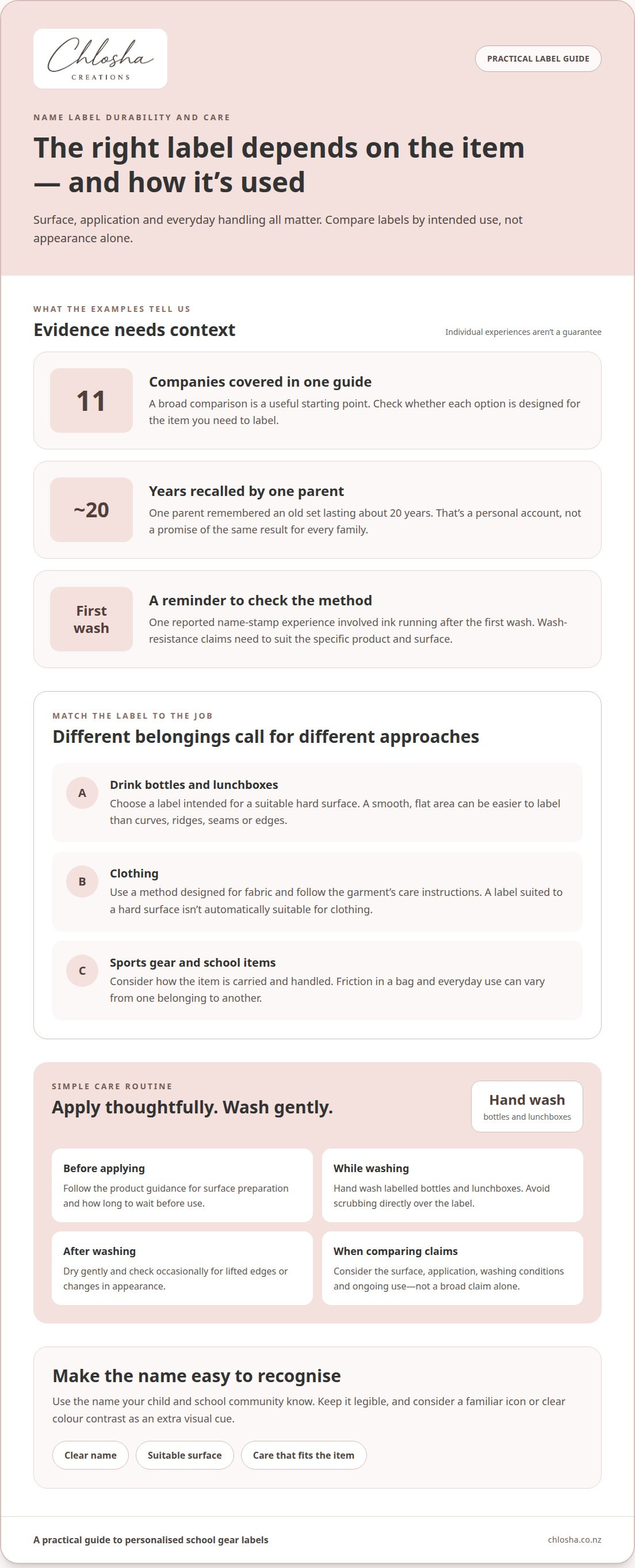
Durability depends on the label type, its surface and daily handling. One guide covered labels from 11 companies, a useful reminder to compare products by intended use rather than appearance alone.
Customer reviews of label durability
Reported experiences vary, so look for details about the item, application and care instead of relying on a broad “long-lasting” description. One parent recalled an old set lasting about 20 years, while another found labels didn’t stay on their children’s shoes. These are individual experiences, not a promise of the same result for every family.
Reviews are most useful when they describe a specific use, such as a name label on a drink bottle or school item used every day. Look for details about how the label was applied and how it held up. For clothing, make sure the label is designed for fabric. Performance on a hard surface does not show that it is suitable for clothing.
Washing and waterproofing performance
Washing can reveal differences between label materials and application methods. One reported name-stamp experience involved ink running after the first wash, marking clothing and sometimes transferring to other items. Ink also seeped through some light-coloured fabrics. This example shows why wash-resistance claims need to match the specific product and surface.
A description such as “100% waterproof” doesn’t explain how a label performs through repeated washing or everyday handling. Look for care instructions relevant to the item, and avoid assuming a label suits a washing machine or dishwasher. For drink bottles and lunchboxes, hand washing is the recommended approach; durability can still depend on the surface, application and ongoing use.
For labels used on hard-surface school gear, the application area matters. A bottle’s curved sides, ridges or textured finish can affect how well a label sits. Choose a smooth, suitable area and follow the product’s application guidance. A label placed across a seam or edge may experience different handling from one on a flat panel. The personalised name labels collection can help you explore options for belongings such as drink bottles and lunchboxes.
Care habits matter too. Hand wash a labelled drink bottle, avoid scrubbing directly over the label, and dry the item gently. Check the label occasionally for lifted edges or changes in appearance. For school clothing, follow the garment’s care instructions and use a label method designed for fabric, rather than treating hard-surface labels as interchangeable.
Personalised Labels for Kids’ School Gear
A useful school label makes a child’s name easy to recognise on everyday belongings. Match its design and format to the items your child takes to school, daycare or kindy.
Personalised designs and customisation
Start with the name your child and school community recognise, such as their first name or familiar short form. Then consider the item: a compact design may suit a pencil case, while a more visible one can help identify a sports bag. When comparing top-rated name labels and customer favourites, use practical details to guide your choice rather than judging appearance alone.
An icon adds a visual cue alongside the name. A child who recognises a star or animal may spot that detail quickly on their belongings. Personalised icon and name labels combine both elements.
Best-selling labels and bottle bands
A popular label won’t necessarily suit every item on a school list. A name label for a lunchbox serves a different purpose from one intended for clothing or sports gear. Check that the name will be legible and that the label suits the item’s surface.
Personalised water bottle bands are another format parents may encounter. They differ from labels applied directly to a bottle, so consider which option suits the bottle and your child’s routine. Matching a name or icon across a bottle, lunchbox and sports bag can also make the set easier to recognise.
Icons, colours and medical information
Yes, labels can include icons, colours and allergy information. An icon can help a child identify their belongings, while an allergy alert label can make an important message visible. Keep names and alert wording clear, and choose colours that make the text easy to read.
For example, concise allergy wording on a lunchbox can help identify a relevant need. The label supports identification; it does not replace the child’s usual care arrangements.
Production details can help families plan for a school term. Custom items are “Made to order in 1-3 working days” and “Processing time: 2‑5 business days”. Delivery time depends on the destination, so allow for transport as well as production.
Before choosing, list the belongings your child takes to school, daycare or kindy, such as a drink bottle, lunchbox, clothing and sports gear. Match each item with a suitable label type. A name-and-icon design may help distinguish a bottle, while clear alert wording serves another purpose. This shortlist can narrow your options. When comparing top-rated name labels and customer favourites, prioritise readability, useful personalisation and the item each label needs to identify.
Stick-On Name Labels for School Gear
Stick-on labels can suit smooth, hard school items, such as a lunchbox or pencil case. The surface and intended use matter: a label for bottles is not automatically suitable for clothing or every kind of washing.
Choose labels for the right surface
For a drink bottle, choose a label intended for hard surfaces. Curves, ridges and textured finishes can affect how neatly a label sits. A flat area on a lunchbox or storage container may be a better placement than a seam or edge. Follow the product’s application guidance, including advice on surface preparation and how long to wait before use.
Waterproof and scratch-resistant are specific performance claims, not a guarantee of how every label will fare. Exposure to water, friction from bags and handling can vary between items. For example, a bottle carried loose beside keys experiences different contact from one stored in a lunchbox compartment. Read care information for the label and item together.
Clothing labels need a different approach
Stick-on clothing name labels are generally placed on a garment’s care or brand label, rather than directly on fabric. This gives the label a tag surface to adhere to. Shirts without a suitable tag may need another clothing-identification method. Labels intended for fabric can still fail to adhere or come away during wear or washing, so don’t assume every label works on every garment.
Iron-on and sew-on labels are separate options for clothing. Iron-on labels are applied with heat and can eventually peel with extended use. Sew-on labels may suit garments kept for longer, while stick-on formats can be more convenient for hard items such as drink bottles and lunchboxes. These methods aren’t interchangeable, so match the type to the item.
Set realistic expectations for wear
A label’s performance depends on its material, placement and use. A label on a frequently handled lunchbox may experience more rubbing than one on a classroom storage container. Consider these differences before choosing a format, especially for school shirts, shoes or items that are regularly washed.
Choose UV DTF transfers for suitable smooth, hard surfaces, not fabric. They aren’t iron-on or sew-on clothing labels. When comparing stick-on options, prioritise clear care instructions and a stated use that matches the item. This helps you choose labels for kids’ school gear without assuming that “waterproof” means suitable for every surface, wash or handling condition.
Applying and Caring for Labels
Placement and gentle care both affect how a label holds up. For a drink bottle, a smooth, clean, dry area provides a suitable surface. Avoid placing a transfer across a ridge, seam or curved edge, where contact may be uneven. Follow the product’s application guidance, including instructions about curing time before use.
Parents often prepare several items together, such as a lunchbox, bottle and pencil case. Treat each surface separately: check for dust, moisture or texture before applying a label. Applying one over an existing mark or rough patch can affect how evenly it sits. Once in place, avoid picking at the edge while the adhesive cures.
“Permanent” doesn’t mean indestructible. Friction from a school bag, frequent handling and water exposure can all affect a label over time. A bottle carried beside keys, for example, faces more rubbing than one stored in a separate lunchbox pocket. Check labels occasionally for lifting or changes, especially on everyday gear.
For drink bottles and lunchboxes, hand washing is the recommended care approach. Use a soft cloth and avoid scrubbing directly across the label. Dishwasher or microwave safety isn’t claimed; dishwasher durability can depend on the surface, correct application, curing time, washing conditions and ongoing use. Even a label described as waterproof shouldn’t be treated as guaranteed to withstand every washing method.
Clothing needs a different care plan. Stick-on clothing labels are generally placed on a garment’s care or brand label, not directly on fabric. Laundry conditions and fabric movement can affect how labels stay in place, so don’t assume a hard-surface transfer is suitable for a shirt or uniform. Choose a method intended for clothing and follow its care instructions.
Washing guidance matters when choosing and using name labels. Ink-based marking and adhesive labels behave differently, so consider the item and method rather than treating all name labels alike.
For school gear, group care by item: hand wash labelled bottles and lunchboxes, and follow garment instructions for clothing. Check each label’s placement and care guidance before regular use. These habits help parents manage labelled belongings without relying on claims of dishwasher-proof, laundry-safe or permanent performance.
Custom Name Label Design Options
A thoughtful design makes a name easier to recognise on busy school gear. Start with the label’s purpose: identify a lunchbox, distinguish a drink bottle or flag an allergy. Then choose the information and visual details that help with that task. Clear lettering matters more than decorative extras when a child needs to spot belongings quickly.
For a child learning to recognise their name, pair it with a familiar icon, such as a star or animal. The picture offers another visual cue on a bottle or pencil case. Keep the name prominent, so the icon supports identification rather than competing with the text. A simple layout can be easier to scan than one crowded with decorative elements.
Colour can help distinguish belongings too. For example, a child might associate one colour with their lunchbox and another with their sports gear. Treat colour as a visual aid, not the only identifier; a clearly printed name still matters when items look similar. Consistent design details across daycare, kindy or school gear can make a matching set easier to recognise.
Some parents consider adding a mobile number to a name label. Decide what information is appropriate for the item and where it will be visible. A label on a lunchbox may be seen by different people than one inside a bag. Keep the name readable and avoid squeezing extra details into a small design.
Allergy alert labels serve a different purpose from standard name labels. They can make an allergy message visible on a relevant item, such as a lunchbox. Use concise, clear wording that can be read at a glance. An alert label supports identification, while the child’s usual care arrangements remain important.
Before settling on a design, consider the space available on the item. A small pencil case may suit a name and compact icon, while a larger lunchbox can accommodate a more noticeable layout. Check that the lettering remains easy to read at the intended size. A design that looks clear on screen should also suit the surface where it will be applied.
The best customisation is purposeful: choose a readable name, add an icon or colour that helps recognition, and include extra information only when useful. For school and daycare gear, this balance keeps the design personal without sacrificing clarity.
Chlosha Creations
Chlosha Creations is an NZ business offering personalised labels for children’s everyday belongings. Its range includes Personalised Name Labels, Personalised Icon + Name Labels, Kids Name Labels and School Name Labels. These options help families identify school and daycare gear. Choose according to the item and the visual details that suit the child.
Personalised Name Labels keep the child’s name as the main identifier, making them a straightforward option. Personalised Icon + Name Labels pair a name with an icon, adding a visual cue a child may recognise. For example, an icon beside a name can help distinguish a lunchbox from similar items in a shared school space. Choose a design that keeps the name easy to read.
Kids Name Labels and School Name Labels are useful starting points for organising children’s belongings. First consider what needs identifying: a drink bottle, lunchbox, stationery or sports gear. That simple list helps match the label to its intended use. Clothing needs a method designed for fabric; UV DTF transfers are for suitable smooth, hard surfaces, not fabric.
Chlosha Creations primarily uses premium UV DTF transfer technology. On suitable items, the finish is clean, smooth and no-background. For example, a family might choose a name-and-icon design for a child’s bottle and a name-only option for another compatible item. Each surface still needs to be suitable, so consider the item before selecting a transfer.
Personalisation can support different family routines, from preparing school belongings to identifying items used at daycare or kindy. A familiar name can make ownership clear, while an icon gives a child another detail to recognise. Legible wording and a design suited to the item help make each label practical as well as personal.
There’s no single label format for every child’s gear. A name-only design offers a direct identifier; an icon-and-name option adds a visual element. Match your choice to the item, its surface and how the child will use it. This makes it easier to choose labels for a school kit without expecting one format to suit every belonging.
If you’d like to discuss name labels for your child’s gear, get in touch with Chlosha Creations.
Frequently Asked Questions
Which name labels are most popular with NZ parents and customers?
A practical choice for school kits is a pack with several label sizes. For example, the Chlosha Signature Classic Pack contains 12 labels: 2 large, 4 medium and 6 small. That mix gives families options for different-sized belongings, such as a larger lunchbox and smaller stationery item. Choose a pack by the range of items to label, rather than assuming one size will suit every belonging.
Which name labels last best through washing, dishwashing, and outdoor use?
Chlosha’s UV DTF transfers are water-resistant and scratch-resistant, not waterproof or scratch-proof. They’re intended for compatible hard surfaces, including stainless steel, glass, acrylic and ceramic. Outdoor exposure and repeated handling can affect wear, so don’t assume a specific lifespan. Commercial dishwasher use is not recommended. For everyday drink bottles and lunchboxes, consider the surface and how the item is used before choosing a label.
What are the best name labels for school uniforms, shoes, lunchboxes, and drink bottles?
Use a clothing-specific identification method for uniforms. For shoes, a parent has suggested writing a name on the insole with a permanent marker, since labels may not stay on some footwear. On compatible hard lunchboxes and drink bottles, name labels can provide a clear identifier. Assess stainless steel bottles and smooth lunchbox surfaces for suitability before choosing a transfer.
What should buyers check before ordering custom name labels?
Check the spelling and exact name format carefully, especially if siblings use different names or shortened forms. Compare the pack’s label sizes and quantities with the belongings you plan to mark. Colours may appear slightly different depending on your screen settings, and white artwork prints as white ink. For a custom design, supply artwork in a supported file format at a suitable print size—a standard practice recommended by digital print specialists like קמפוס לדפוס דיגיטלי to ensure sharp reproduction and accurate colour rendering.
How do customer reviews compare for NZ name label brands?
Customer experiences vary, so compare reviews by label type, item, application and care rather than relying on broad claims. The guide covered labels from 11 companies, but the examples don’t establish which NZ brand performs best.
